
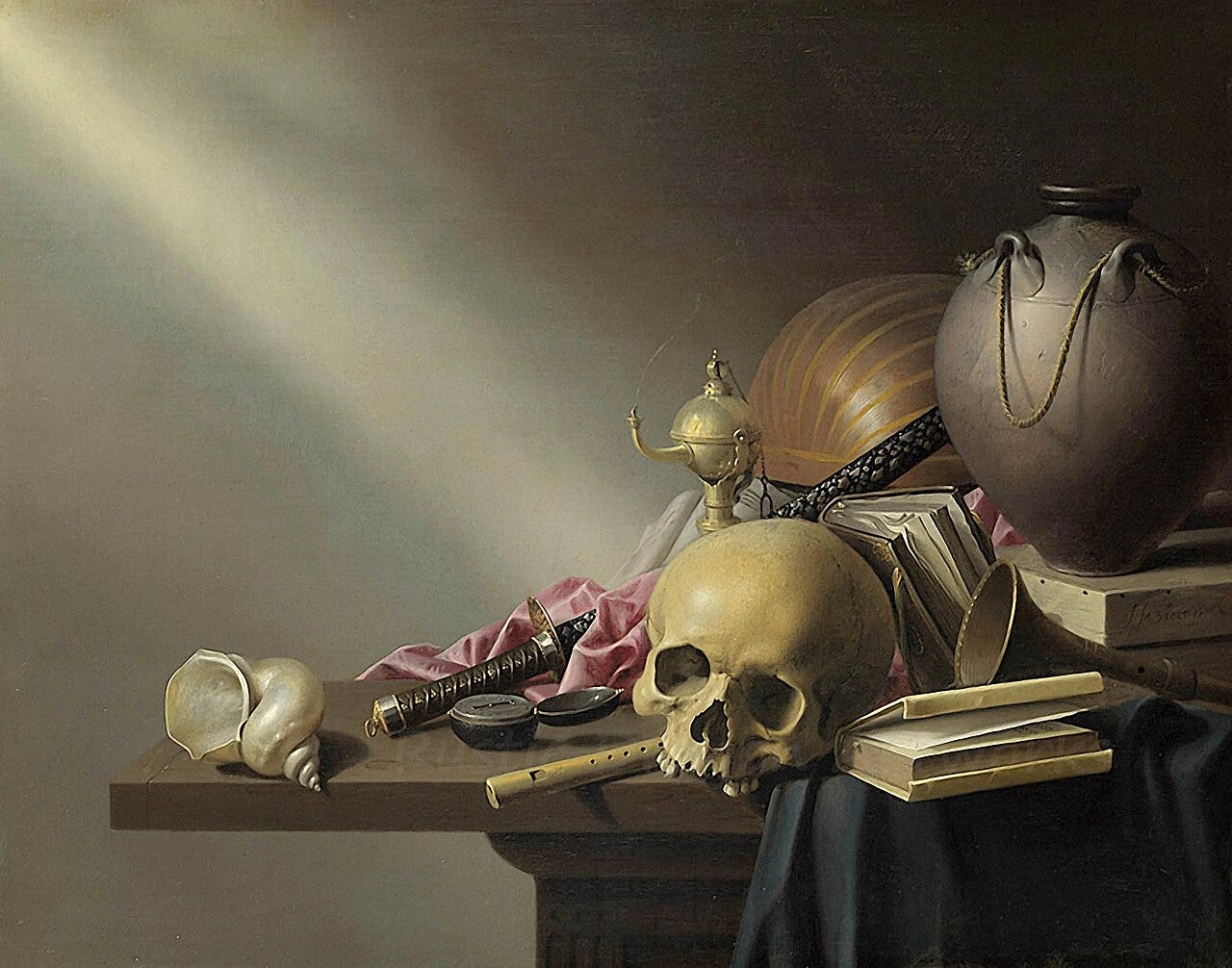
A vanitas is a still life packed with symbols of death and time, a skull, a guttering candle, an hourglass, wilting flowers, reminding the viewer that life is short and nothing earthly lasts.
A moral message disguised as a beautiful arrangement of objects.
The word comes straight from the Bible, the Latin of Ecclesiastes, vanity of vanities, all is vanity.
The form flourished in the Protestant Dutch Republic of the 1600s, above all in the university town of Leiden.
Vanitas in brief
What it is: a still life full of symbols of death and time.
The message: everything you own and enjoy will pass.
The props: skull, candle, hourglass, soap bubbles, dead flowers, books.
The home: the Dutch Republic of the 1600s.
The name: from a line in the Bible, vanity of vanities.
Keep learning art the fun way


A sermon made of objects
A vanitas does not preach in words. It preaches in things.
Every object is a coded message. A skull is death. A snuffed candle and a watch are time running out. Wilting flowers and rotting fruit are decay. Clocks, watches and skulls turn up so often that they carry a whole tradition of paintings about time on their own.
Books and instruments are the vanity of human learning. Coins and jewels are wealth you cannot keep.
Arrange them on a table, paint them with all the skill in the world, and you have a sermon anyone can read.
The trick, the one I love, is that the painting is gorgeous. You are seduced by the very luxury it tells you to renounce.
And do not mistake it for morbid art. These were costly luxury pieces, painted for wealthy collectors to hang at home.
The Bible behind the name
The name carries the whole idea.
It comes from the Latin opening of a verse in Ecclesiastes: vanitas vanitatum, vanity of vanities, all is vanity.
Here vanity does not mean conceit. It means emptiness, the way everything earthly slips through your fingers.
The genre flowered in the strict Protestant culture of the seventeenth century Dutch Republic, the same world that produced the great still life.
A rich, trading, worldly society painting reminders not to love the world too much. That tension is the genre.
The bubble and the skull
Two objects say it best.
The skull is obvious, death staring out from the table. The soap bubble is subtler.
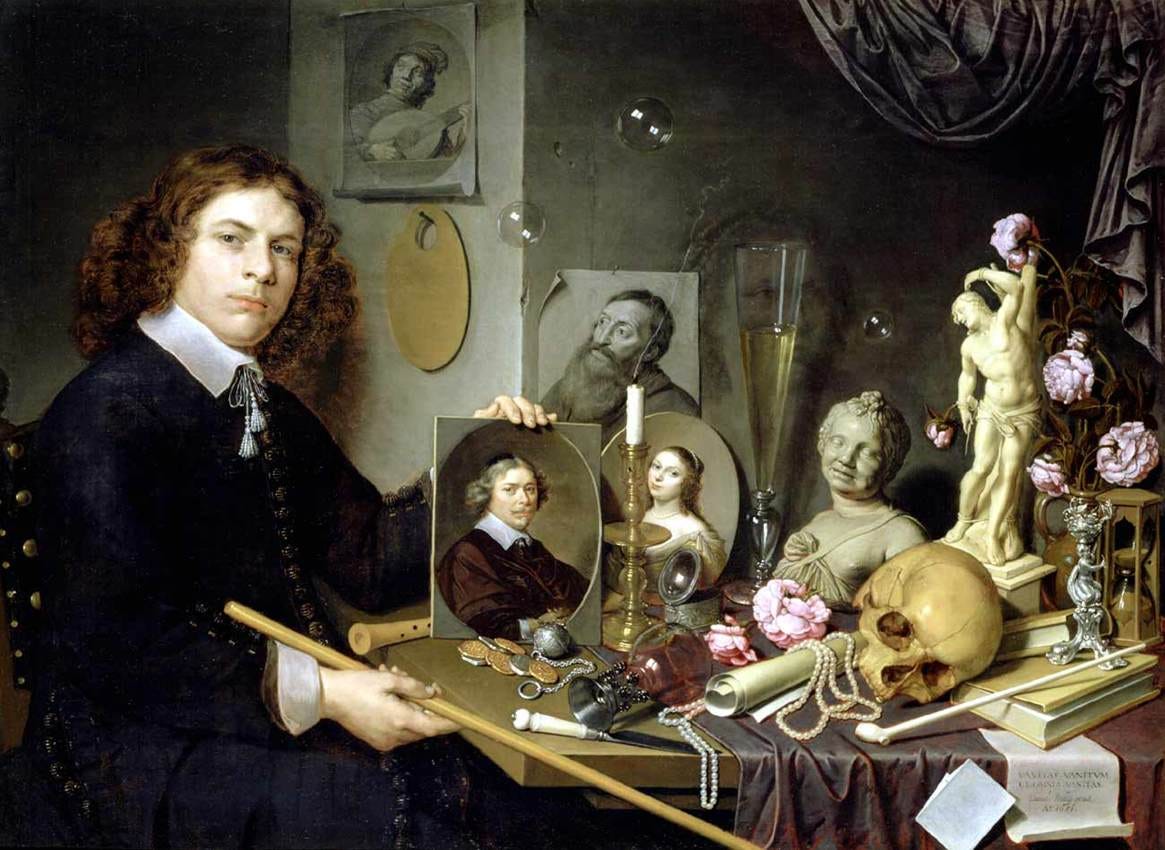
A bubble is perfect, shining, and gone in a second, and Dutch painters loved the old phrase homo bulla, man is a bubble.
A child blowing bubbles is the shortest statement of all: you, too, will pop.
Beauty and disappearance in the same fragile sphere.
The candlelight is part of the sermon
The mood depends on how it is lit.
Many vanitas pictures use deep shadow and a single fall of light, the tenebrism that pulls a skull or a flame out of the dark. The light itself becomes part of the message, brief, precious, surrounded by night.
It is the difference between a catalogue of objects and a meditation.
The best of them feel less like a genre painting and more like a held breath.
And the genre never really died. In 2007 Damien Hirst cast a human skull in platinum and set it with 8,601 diamonds, named it For the Love of God, and priced it at 50 million pounds.
A vanitas for the auction age: death, wealth and vanity in one shining object.
Three vanitas painters to know
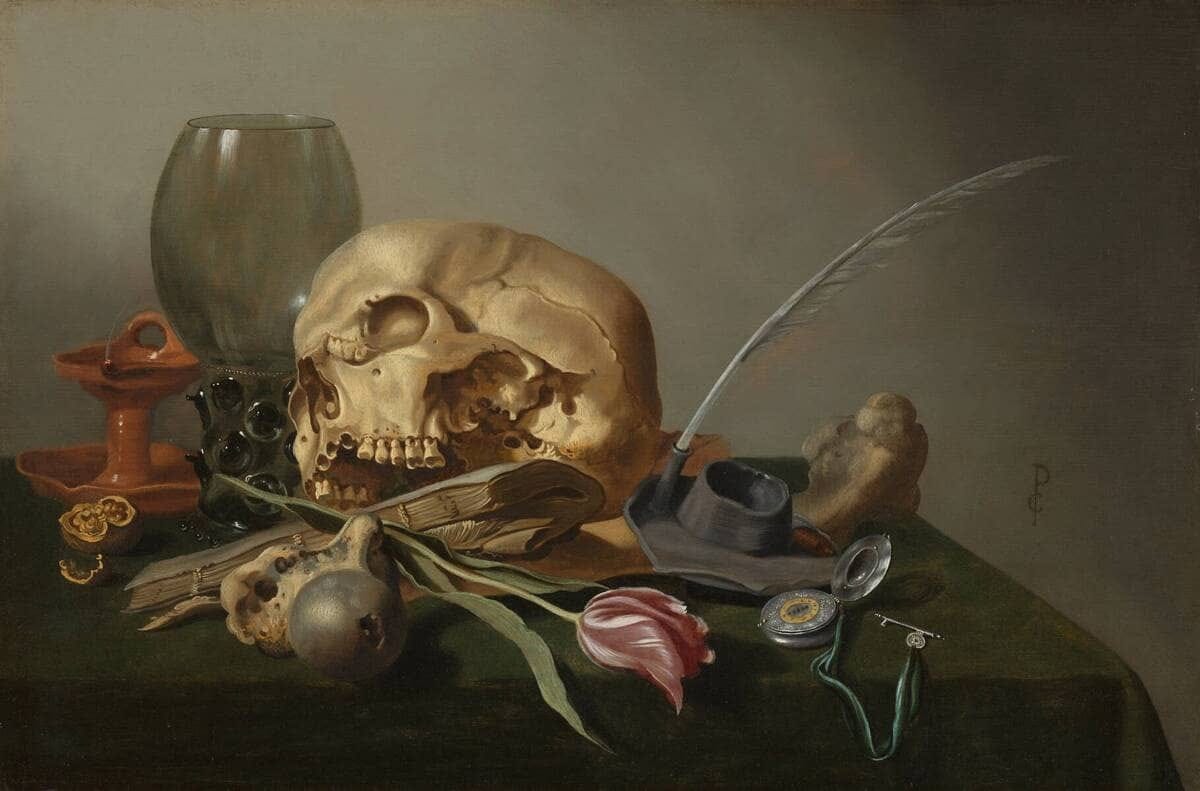
Pieter Claesz: spare, silvery tabletops with a tipped glass, a watch and a skull.
Harmen Steenwijck: the textbook vanitas, books, a shell, a sword and a skull in raking light.
David Bailly: in 1651 he painted himself as a young man ringed by symbols of the age he would not live to reach, the vanitas that haunts me most.
You can see two of the best in person. Steenwijck’s Allegory of the Vanities hangs in the National Gallery in London, and the Rijksmuseum holds a vanitas with a laurel crowned skull.
Hidden symbols of death turn up everywhere, as in 7 secrets hidden in famous paintings.
Vanitas, the questions before the skull
What is a vanitas? A still life filled with symbols of death and time, meant to remind you that life is short.
What do the symbols mean? Skull is death, candle and hourglass are time, wilting flowers and fruit are decay, jewels and coins are fleeting wealth.
Where does the word come from? From the Latin of Ecclesiastes, vanitas vanitatum, vanity of vanities.
When and where was it popular? Above all in the Dutch Republic in the 1600s, and again with Damien Hirst in 2007.
Is it the same as memento mori? Closely related. Memento mori means remember you must die; a vanitas is a still life that delivers that idea through objects.
More secrets to unlock


The loveliest way to be told you will die
A vanitas never frightens you. It seats you before a glowing skull and a half peeled lemon in candlelight, lets the splendor make its point, then quietly reminds you that the bubble always pops.
Homo bulla, the Dutch wrote across these tables: man is a bubble.
