
Famous Paintings of Angels: 12 Visions of Heaven
Nobody knows what an angel looks like, so for two thousand years painters have simply decided. The most famous paintings of angels gave heaven its wings, its faces and its music, and built the picture we all now carry.
Here are twelve of the greatest, all now in the public domain.
From a Russian icon of pure stillness to a Caravaggio angel with dirty feet, artists have made the divine out of real bodies and borrowed wings. I have gathered the pictures that still make people fall silent.
What flies through them:
The messengers. Gabriel and Michael, bringing news or war.
The music. Choirs of angels playing real, exact instruments.
The children. Plump cherubs borrowed from ancient art.
The mystery. Wings and gold standing in for something no one has seen.
If you are the curious type
If this is the kind of art history you want more of:
The Arnolfini Portrait, detail by detail, the mirror, the dog, and the question everyone asks
The darker truth about Gauguin, the part of the Tahiti story that never makes the wall label
Vermeer, Woman Holding a Balance, what is actually on those scales
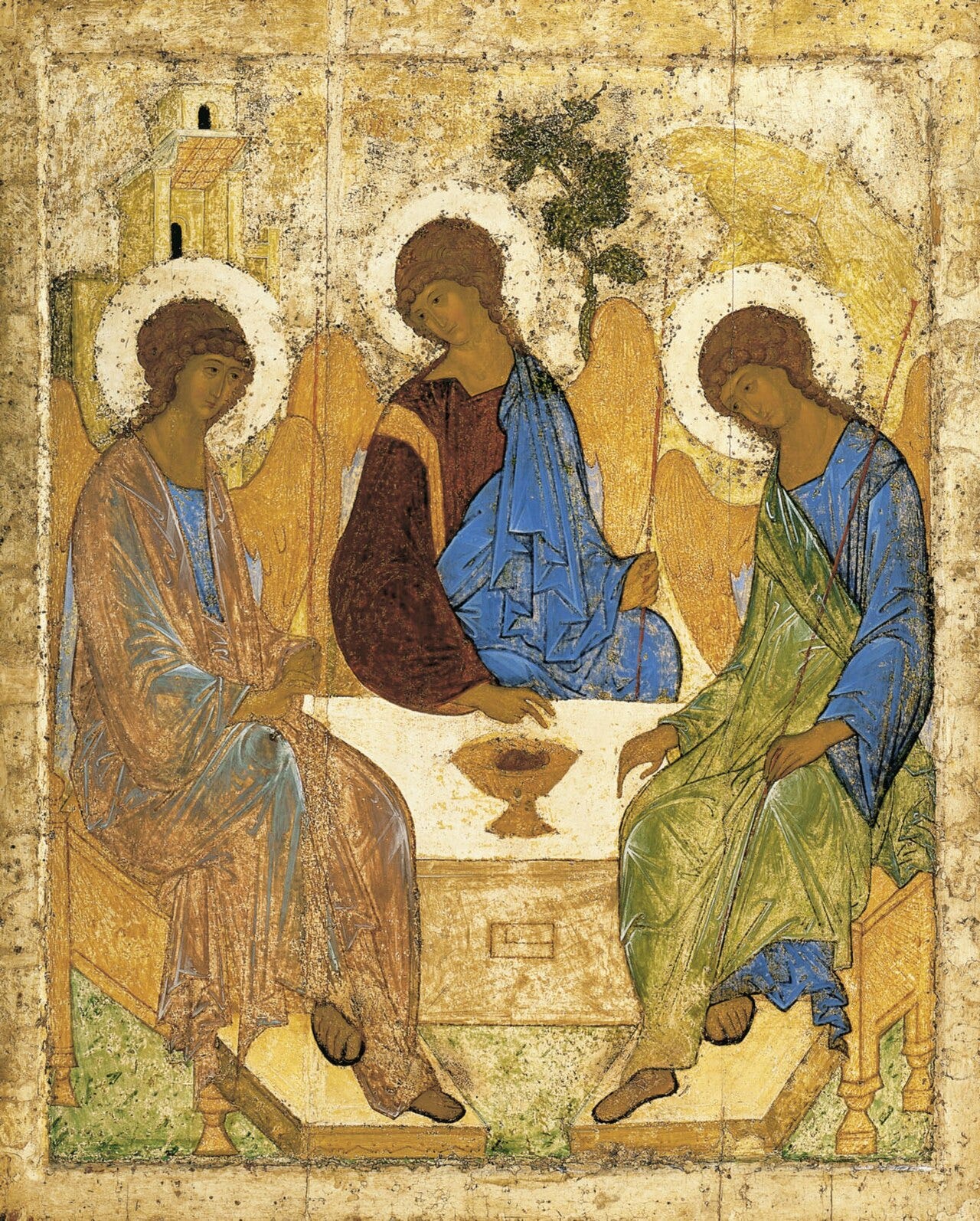
1. Andrei Rublev, The Trinity (about 1425)
Three winged figures sit quietly around a small table, so alike you can barely tell them apart, in the most revered icon Rublev ever painted.
They are the three angels who visited the old man Abraham, understood ever since as an image of the Holy Trinity. There is no drama, only a hush.
The three lean toward one another in a perfect circle, drawing your eye into the empty space at the front of the table, a place set for you.
For centuries the icon was so darkened by candle smoke that no one could see its colors, until it was cleaned in 1904.
It hangs today in the Tretyakov Gallery in Moscow, treated as a national treasure.
2. Fra Angelico, The Annunciation (about 1426)
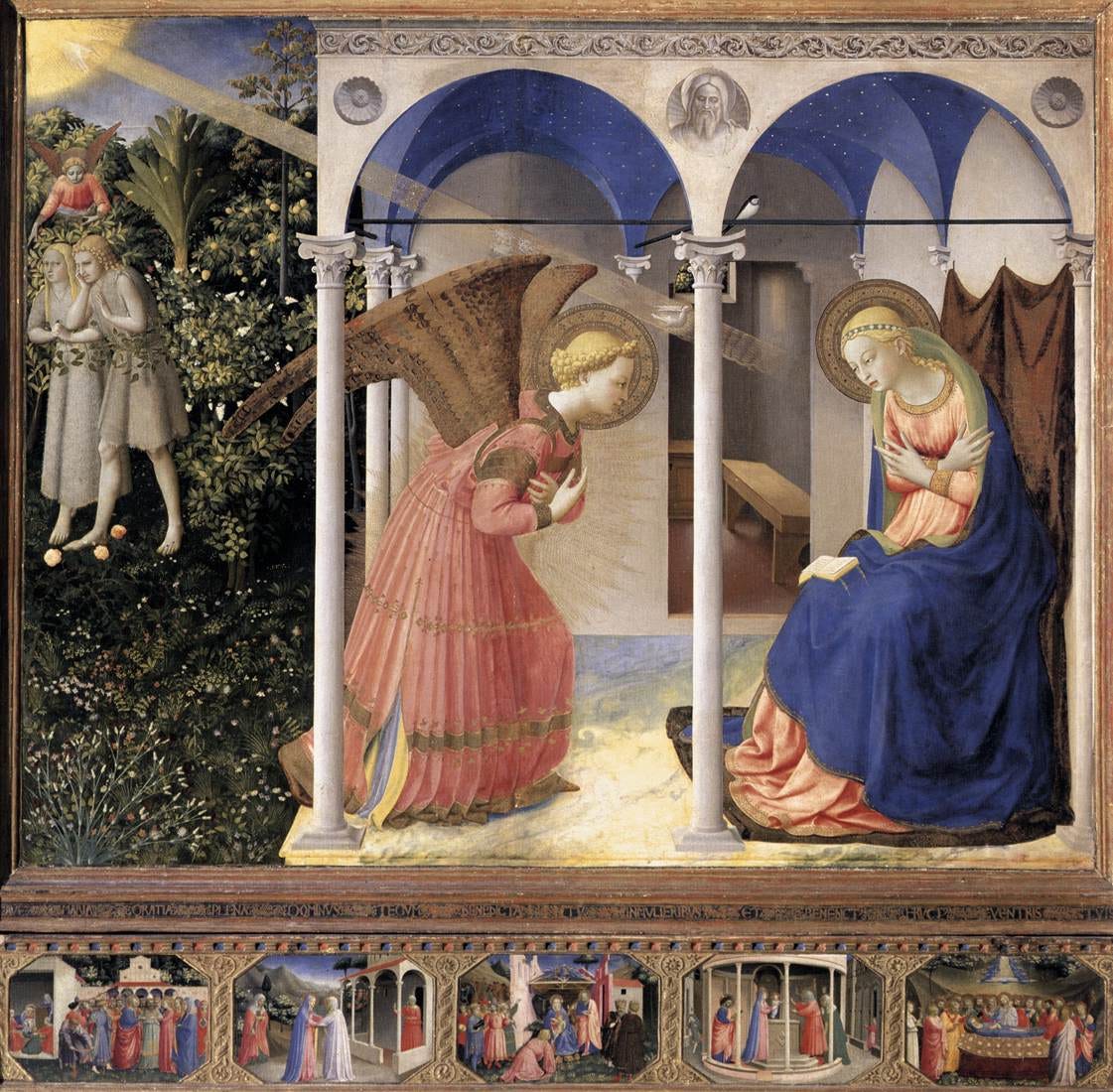
The angel Gabriel bows before a startled Mary under a delicate arcade, his wings banded with rainbow colors, gold light spilling between them.
Fra Angelico was a Dominican friar who was said to pray before he painted and to weep while painting the crucifixion.
His angels are the gentlest in all of art.
Off to the left of the panel, Adam and Eve are driven out of Eden, so that Gabriel's visit reads as the moment the world is offered a second chance. Fra Angelico worked in tempera on wood, building his colors in thin, glowing layers.
The Church later gave him the nickname the Angelic painter and, in the 1980s, declared him blessed.
3. Francesco Botticini, The Three Archangels and Tobias (about 1470)
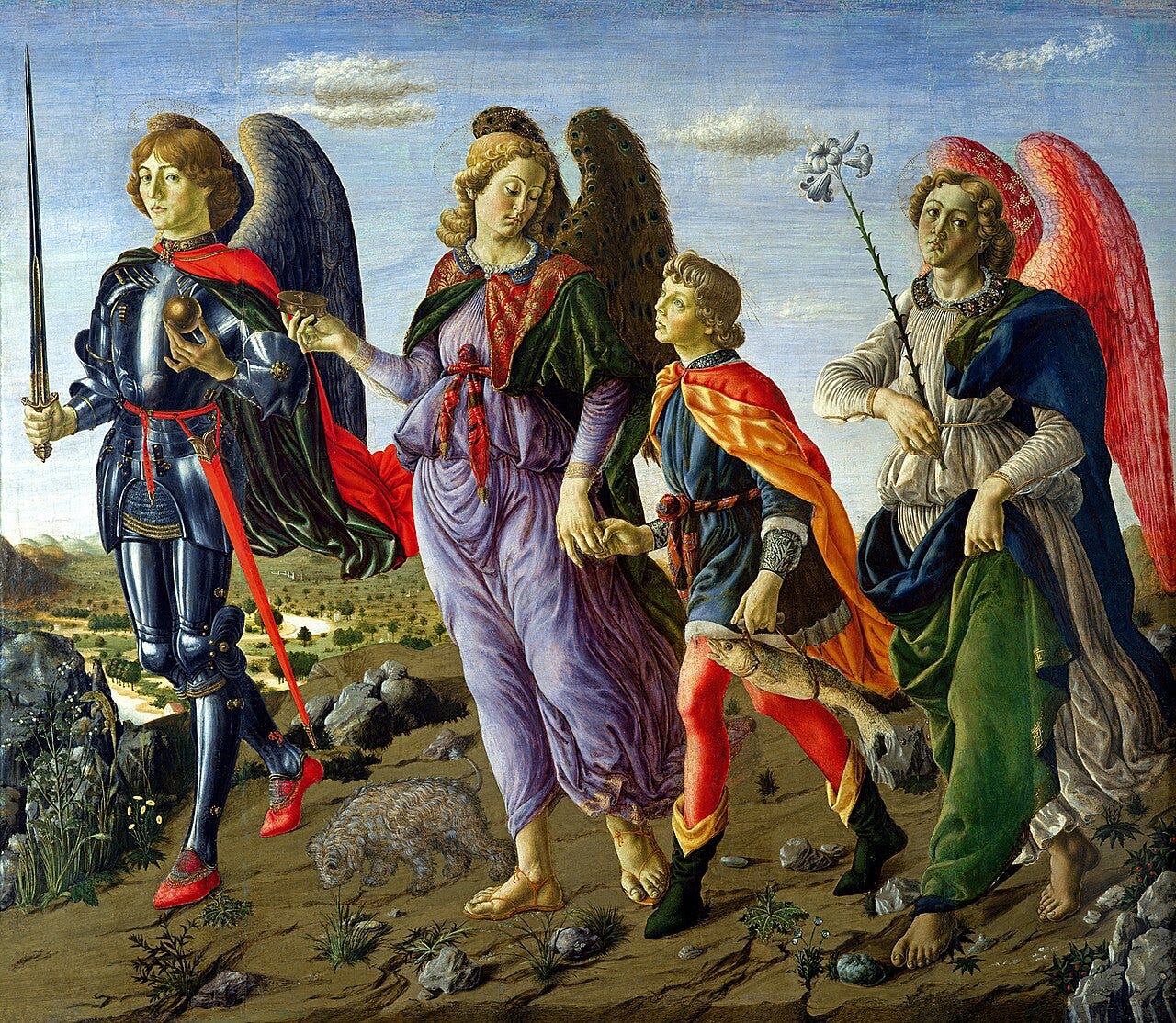
Three great archangels walk a young boy safely along a road, each carrying a sign of who they are. Michael holds his sword, Gabriel a lily, and Raphael leads little Tobias by the hand, a fish tucked under the boy's arm.
Botticini painted it for Florentine families praying to keep their traveling sons safe.
Merchants sent their sons far away on business, so guilds paid for pictures like this to guard them on the road. Rarely do you see the three named archangels together and so tender.
It hangs today in the Uffizi in Florence, a heavenly bodyguard in paint.
4. Hans Memling, Angel Musicians (about 1490)
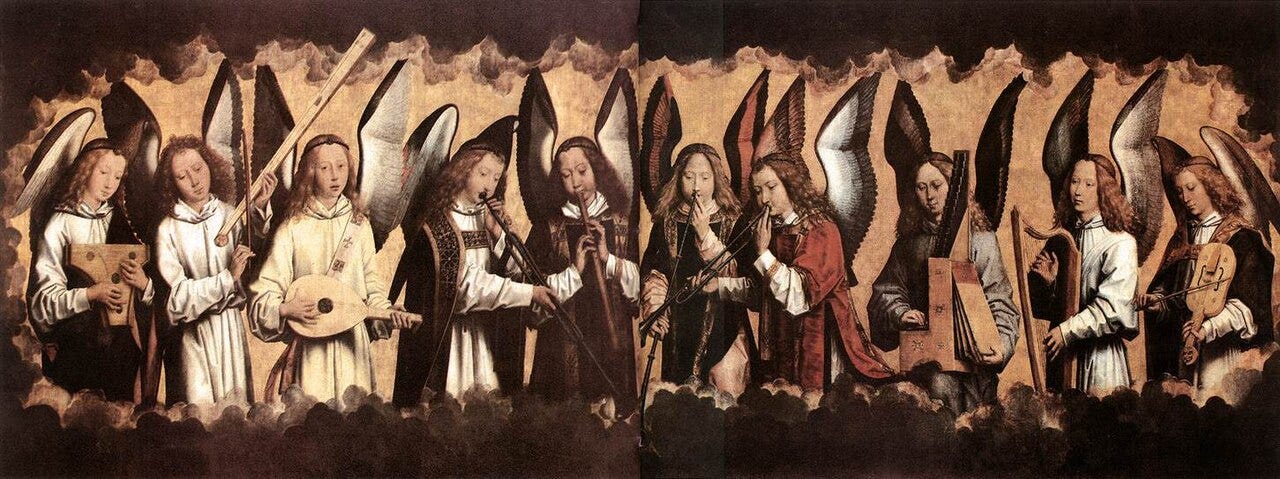
A row of red and gold angels play real instruments, a lute, a harp, a trumpet, a small pipe organ, each one rendered so precisely you could almost build it.
Memling painted them for a great Spanish monastery as part of a heavenly choir around Christ. It is the finest orchestra of angels ever painted.
Musicologists study these panels to learn exactly how instruments looked in the 1400s, down to the strings and the stops. The monastery was wrecked over the centuries, and the panels ended up in a museum in Antwerp.
Every angel plays in tune, if only you could hear it.
5. Rosso Fiorentino, Musical Angel (1522)
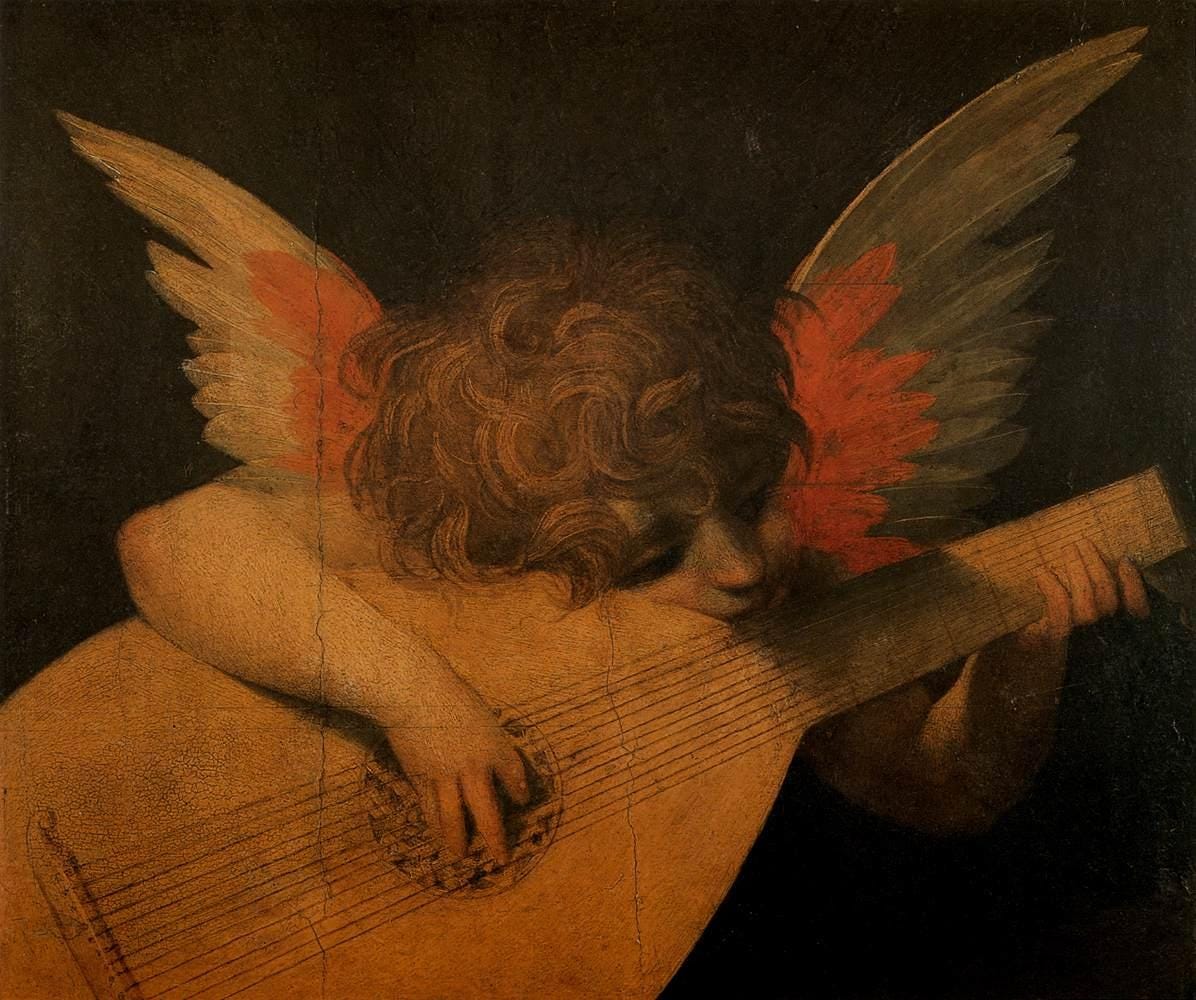
One of the most charming angels in art is a chubby child hunched over a lute, tongue almost sticking out in concentration. It began as a fragment of a larger altarpiece by Rosso Fiorentino, and the little musician has long outshone the rest.
It is pure delight with no message at all.
The plump, tousled angel feels startlingly real, more toddler than heavenly being. It now hangs on its own in the Uffizi in Florence, where crowds coo over it like a baby.
Rosso later fled Italy for France, where he helped carry the Renaissance to the court of the king.
6. Raphael, The Cherubs of the Sistine Madonna (1512)
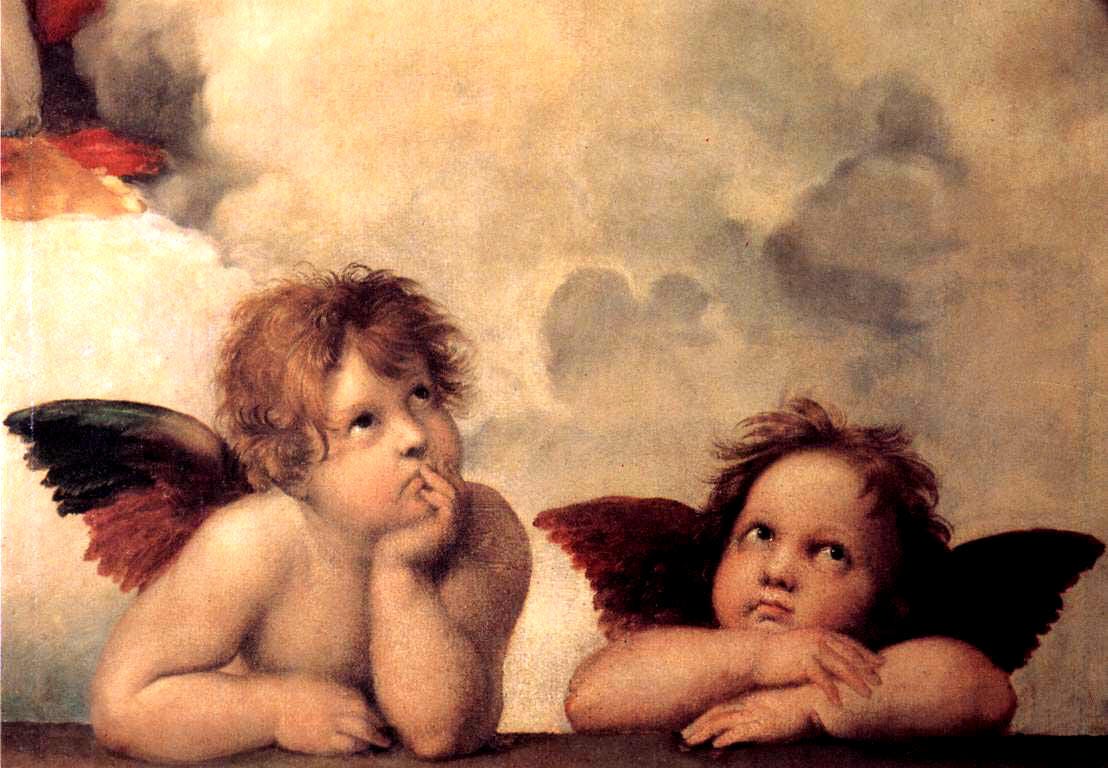
You have seen these two bored little angels a thousand times, on mugs, cards and posters, without knowing they came from a great altarpiece.
Raphael tucked them along the bottom edge of his Sistine Madonna, leaning on a ledge, chins in hands, gazing up.
They may be the most reproduced angels in the world.
Legend says Raphael added them at the last moment, inspired by two children who leaned bored on his studio door. For four hundred years almost nobody noticed them, until the nineteenth century made them famous on their own.
The whole picture hangs in Dresden, but only the two cherubs travel the globe.
7. Caravaggio, Rest on the Flight into Egypt (about 1597)
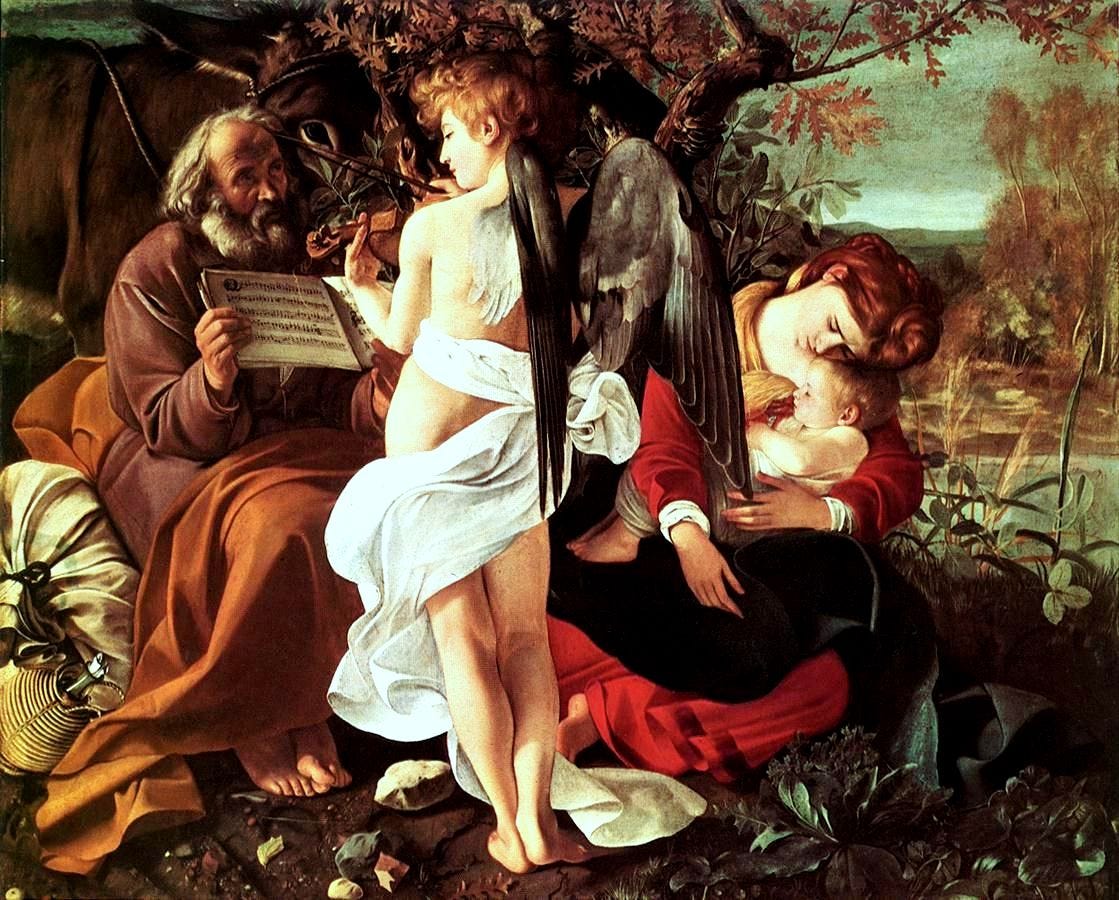
A young angel stands with its bare back to us, playing a violin, while Joseph holds the music and Mary sleeps with the baby. This is an early, tender Caravaggio, far softer than the violent scenes that made him famous.
The angel is the still heart of it.
The music Joseph holds is real and readable, a hymn to the Virgin that scholars have since played aloud. Caravaggio built the whole scene from live models off a Roman street, giving even the angel dirty feet.
It hangs in the Doria Pamphilj gallery in Rome, one of the gentlest things he made before his life turned violent.
8. Guido Reni, The Archangel Michael (1636)
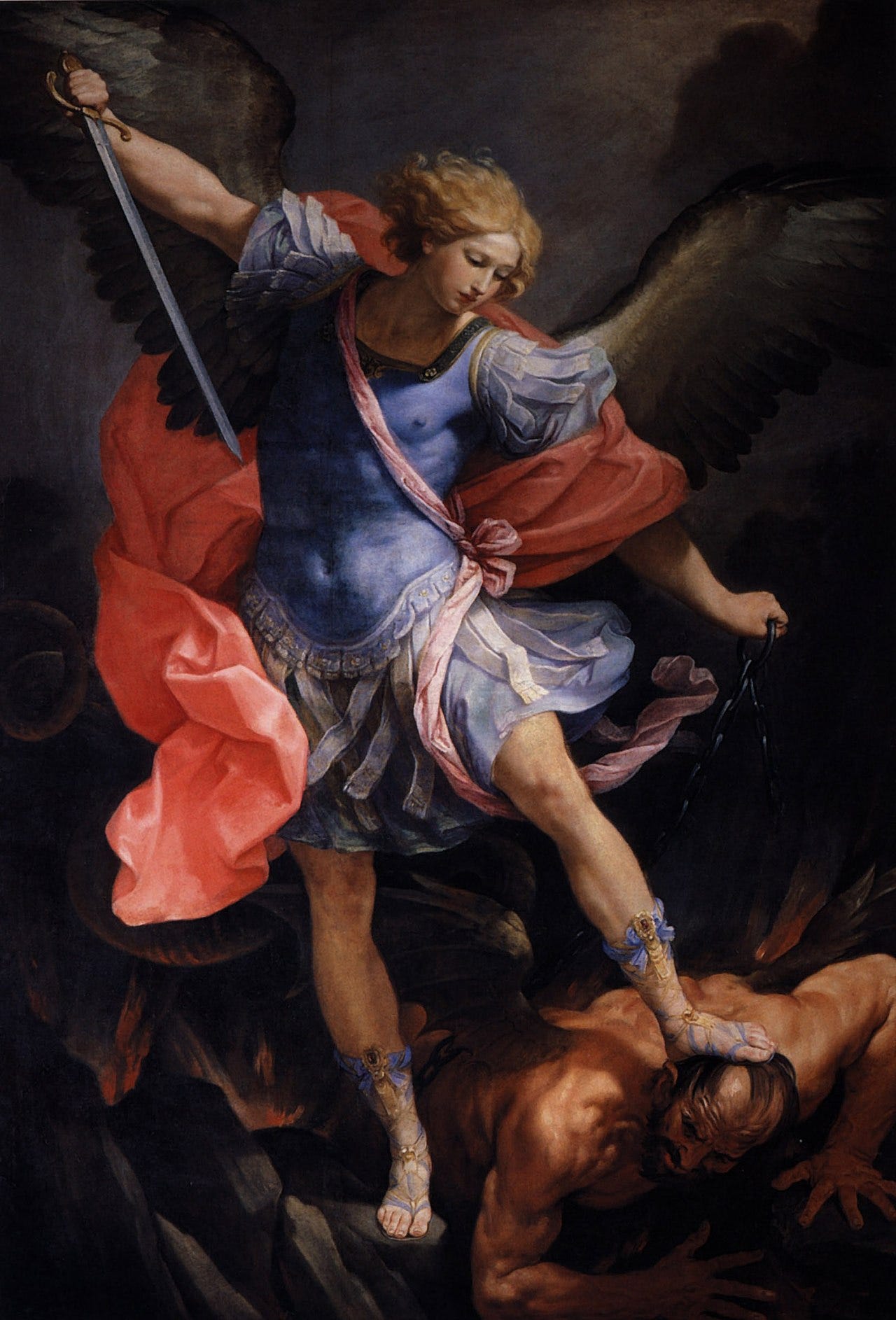
The archangel Michael plants a foot on the chest of a fallen Satan, sword raised, calm and beautiful in gleaming armor. Reni painted the fight as if it were already won, the angel barely ruffled.
It became the model for how the West pictures Michael to this day.
Gossip claimed Reni gave the defeated devil the face of a cardinal he disliked, though no one has ever proved it. The picture hangs in a Capuchin church in Rome, where it was meant to inspire and to warn.
Copies of it spread across the Catholic world for centuries.
9. Rembrandt, Jacob Wrestling with the Angel (about 1659)
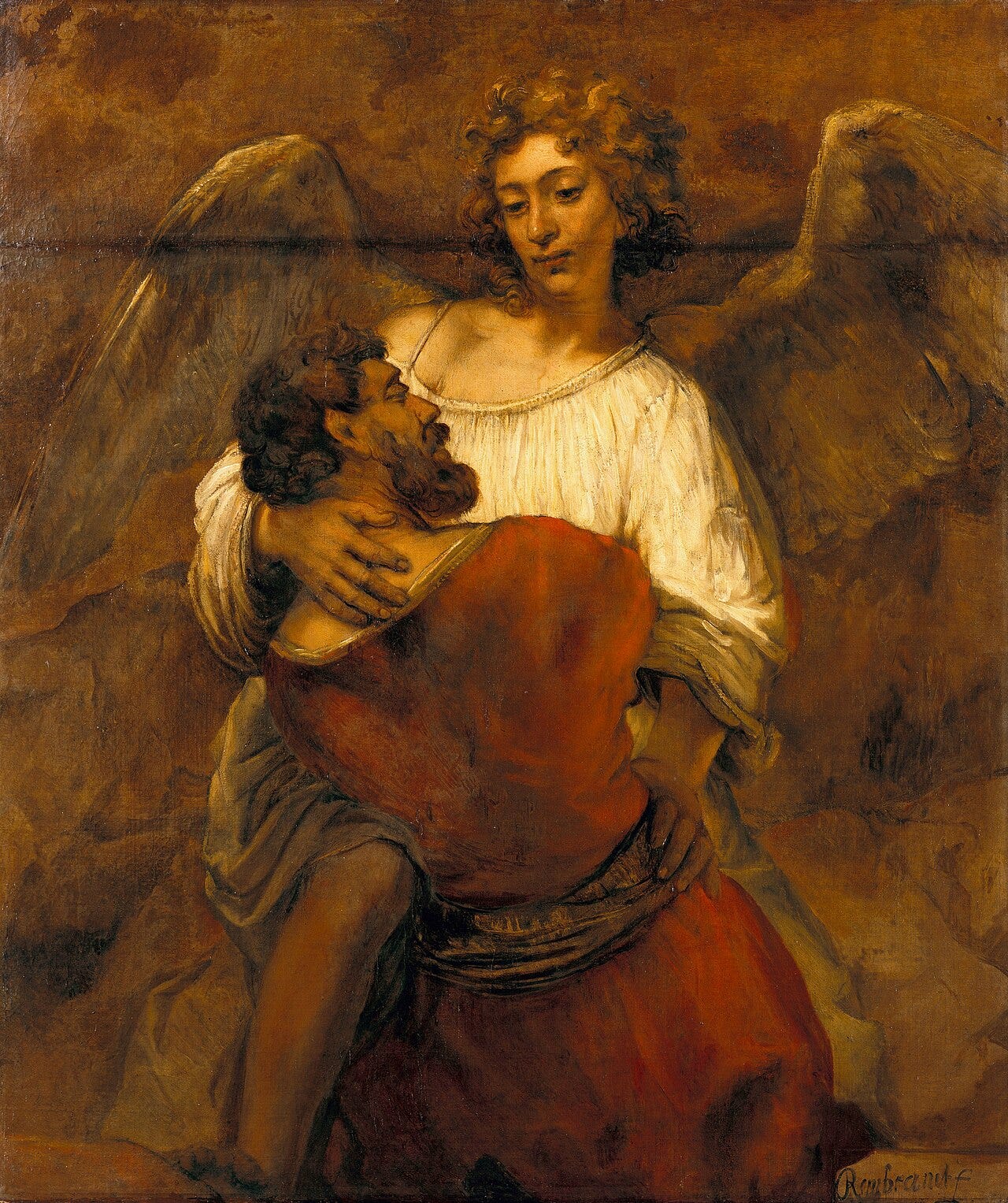
The Bible says Jacob wrestled an angel all night, but Rembrandt paints something closer to an embrace. The angel holds the exhausted man almost gently, one wing curved around him, and it is hard to tell struggle from tenderness.
That ambiguity is the whole point.
In the story Jacob refuses to let go until the angel blesses him, and he limps away forever after. Rembrandt strips out the violence and gives us two figures caught in the dark, close as lovers.
The canvas was later trimmed down one side, and what survives now hangs in the picture gallery in Berlin.
10. William Adolphe Bouguereau, Song of the Angels (1881)
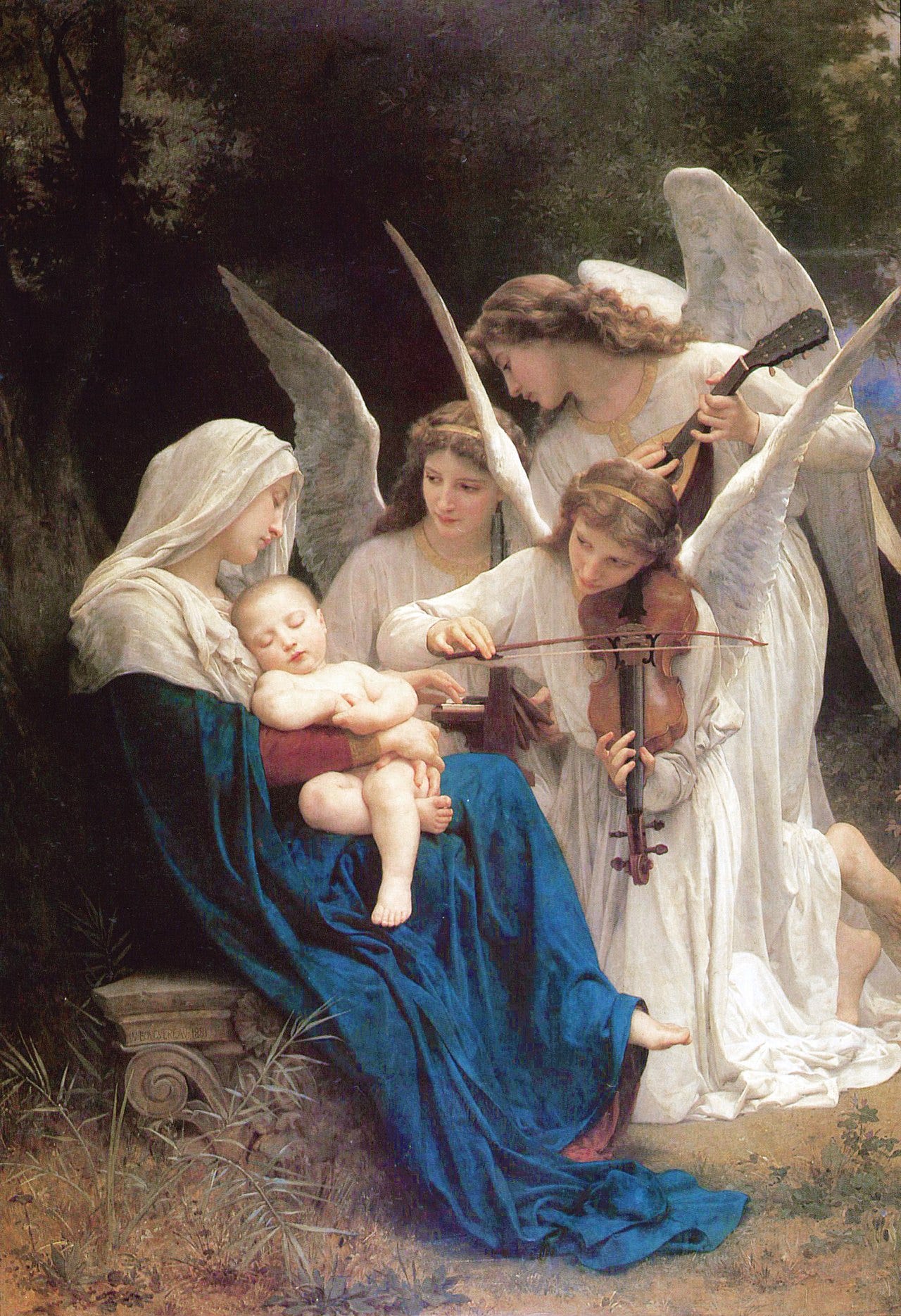
Three angels lean in to serenade a sleeping Mary and child, one bowing a violin, the others hushed, everything smooth as polished marble.
Bouguereau was the most admired French painter of his day, and this is Victorian angel painting at its sweetest. Critics later mocked it as too pretty.
For decades he was more famous than any Impressionist, then almost erased from the story for being sentimental. The wheel has turned again, and crowds now line up for him. This Song of the Angels hangs in a museum in California, beloved once more.
11. Edward Burne Jones, An Angel Playing a Flageolet (about 1878)
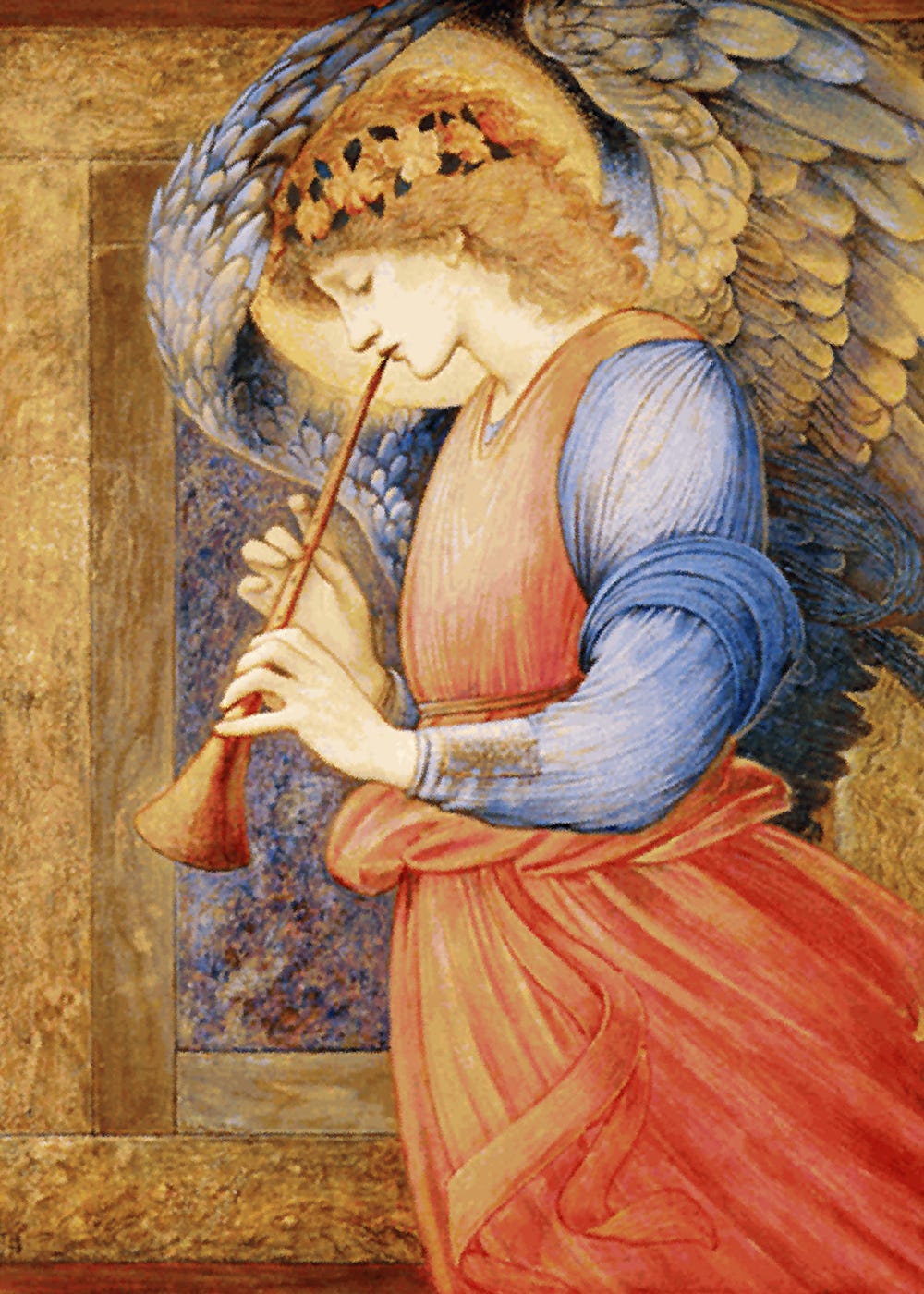
A single tall angel in flowing robes bends over a little flute, wings rising behind, lost in the music. Burne Jones, a leader of the second wave of Pre Raphaelites, filled his work with dreaming figures from a world that never was.
His angels are all longing and no fear.
He designed it partly with stained glass in mind, which is why it glows like a window even in paint. Burne Jones and his friend William Morris covered churches across Britain with angels like this one.
This version is kept at the Lady Lever gallery near Liverpool, built by the soap magnate who fell for Pre Raphaelite art.
12. Abbott Handerson Thayer, Angel (1887)
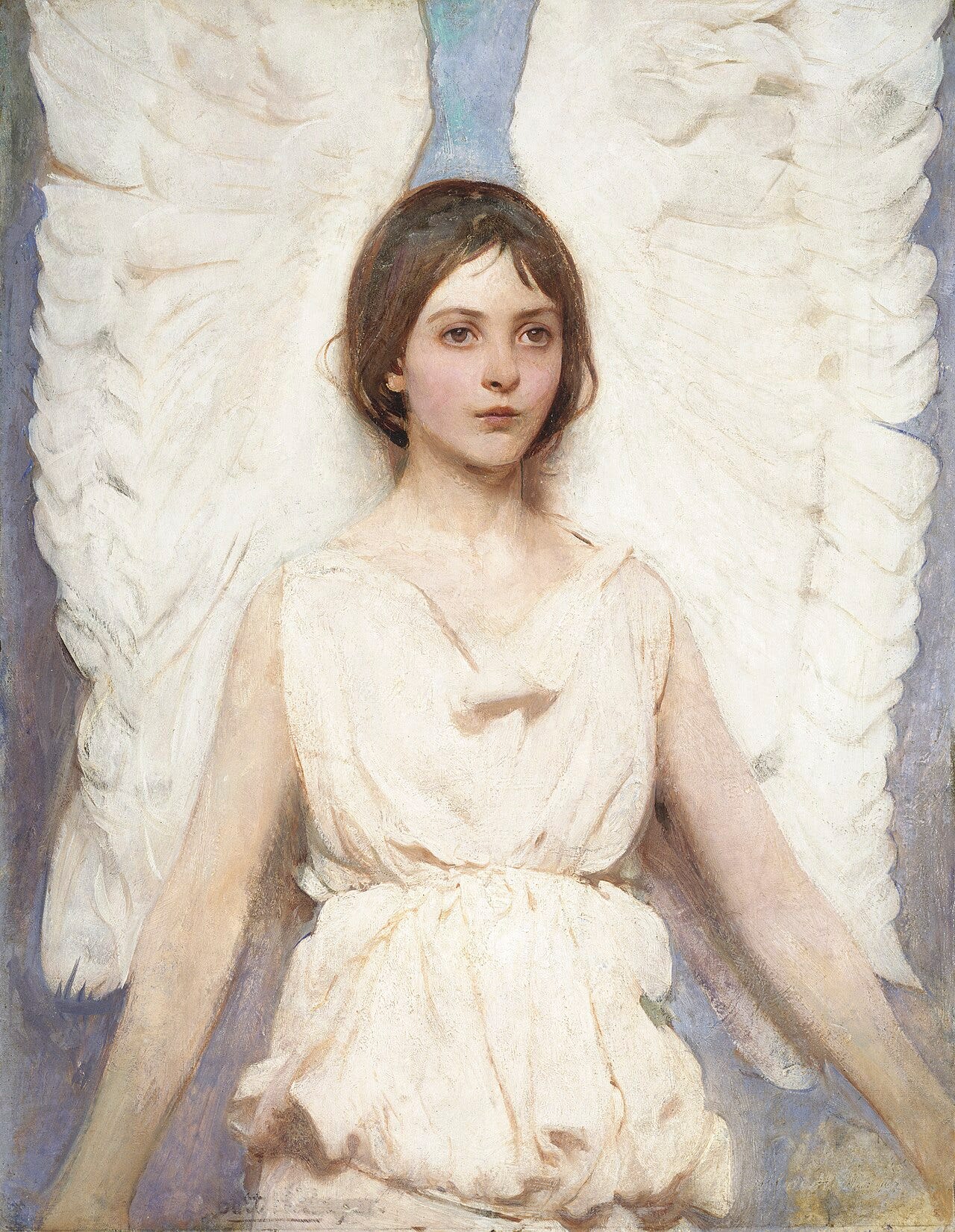
An American painter looked at his own young daughter, gave her a pair of wings, and made one of the best loved angels in United States art.
Thayer used his children again and again as models for winged, white robed figures. He was not religious, but he believed in a kind of ideal purity.
Oddly, Thayer was also a serious naturalist whose studies of animal camouflage later helped shape military uniforms in the First World War.
His angel wings were painted from real birds he had studied closely. This Angel hangs in the Smithsonian in Washington, half girl and half dream.
The churches and museums that keep them
Andrei Rublev, The Trinity: the Tretyakov Gallery, Moscow.
Fra Angelico, The Annunciation: the Convent of San Marco, Florence.
Francesco Botticini, The Three Archangels and Tobias: the Uffizi, Florence.
Rosso Fiorentino, Musical Angel: the Uffizi, Florence, and Caravaggio, Rest on the Flight into Egypt: the Doria Pamphilj, Rome.
Rembrandt, Jacob Wrestling with the Angel: the Gemaldegalerie, Berlin.
Abbott Handerson Thayer, Angel: the Smithsonian American Art Museum, Washington.
If these angels pulled you in, keep going:
Inside Monet house at Giverny, room by room, including his own bedroom
The Ambassadors, detail by detail, the object at the bottom that only works from one side
Luncheon of the Boating Party, detail by detail, who everybody at that table actually was
Paintings of angels, a few quick questions
What is the most famous painting of angels? Raphael's two cherubs from the Sistine Madonna are the most reproduced, though Rublev's Trinity is the most revered.
Why do angels have wings? Painters borrowed wings from ancient winged victories and spirits to show that angels move between heaven and earth, faster than any human.
What are the different kinds of angels? Art shows archangels like Michael and Gabriel as warriors and messengers, plump cherubs as childlike spirits, and choirs of angels making music around God.
Who painted angels best? Fra Angelico for their sweetness, Caravaggio for their realness, and Rublev for their stillness, each for a different reason.
Where can I see famous angel paintings? The Vatican, the Uffizi, the Tretyakov in Moscow and the great churches of Rome and Florence hold the finest.
Messengers we keep repainting
Because no one has seen an angel, every one of these is an invention. Painters borrowed wings from pagan goddesses, faces from their own children, and armor from real soldiers, and out of those scraps they built the heaven we all now picture.
Whether you believe in them or not, these are the images your mind reaches for when you hear the word. We gave the divine its look, one painting at a time.