
Frida Kahlo (1907 to 1954) was the Mexican painter who turned a lifetime of pain, heartbreak and politics into the most personal art of the twentieth century, and became a global icon long after her death.
Crippled first by polio and then by a streetcar crash at eighteen, she painted mostly herself, turning a broken body, a volcanic marriage to Diego Rivera and a life of politics into some of the most recognized images in modern art.
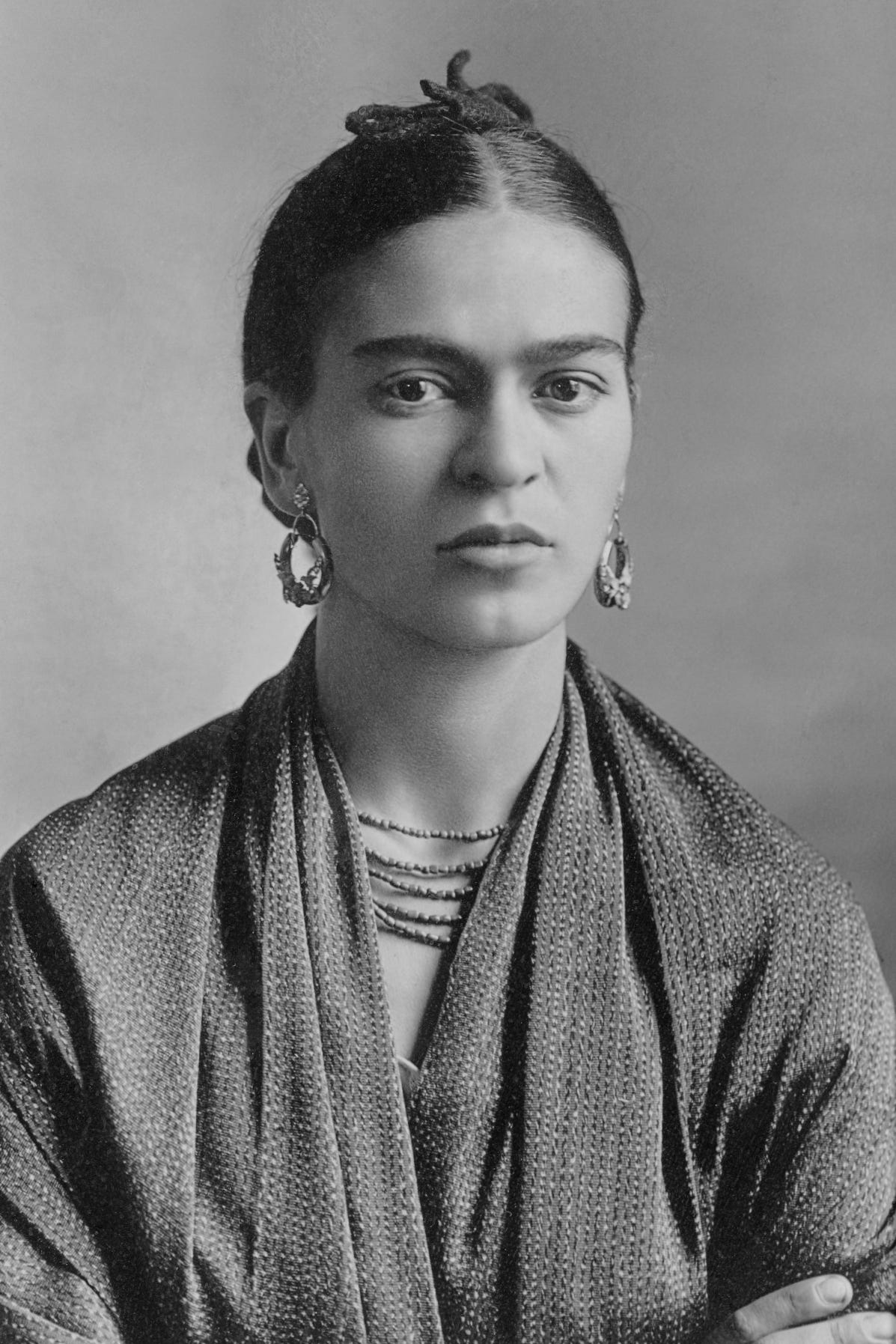
A childhood illness, a horrific accident at eighteen, a stormy marriage to Diego Rivera, an affair with Trotsky and a body slowly falling apart: her life reads like a novel, and she painted nearly all of it.
Here is the whole woman, beyond the flower crown on the tote bags.
Frida in sixty seconds
Lived: 1907 to 1954, in Mexico City, dead at 47.
Defined by: a streetcar accident at 18 that broke her body for life.
Married: the muralist Diego Rivera, twice.
Politics: a committed communist who hosted Leon Trotsky.
Fame: mostly posthumous, exploding decades after she died.
She married Diego Rivera in 1929, divorced him in 1939, and remarried him about a year later, a back and forth covered from his side in Interesting Facts About Diego Rivera.
More incredible painter stories
If Frida Kahlo pulled you in, you will love these too:


A childhood marked by illness
Frida was born in 1907 in Coyoacan, on the edge of Mexico City. She later claimed 1910 instead, so her life would line up with the start of the Mexican Revolution. More on where Frida Kahlo was from.
At six she caught polio, which left one leg thinner and weaker than the other. She was already a girl who knew about pain and being stared at. The worst was still ahead.
The accident that changed everything
At eighteen, the wooden bus she was riding was hit by a streetcar. A steel handrail went straight through her body.
Her spine, pelvis, ribs, collarbone and leg were shattered. She endured around thirty operations over the rest of her life and was often trapped in plaster casts and bed. The full story is here: what happened to Frida Kahlo.
Diego Rivera, the great love and the great wound
In 1929 she married Diego Rivera, Mexico’s most famous muralist, twenty years older and twice her size. Her mother called them the elephant and the dove.
They adored and betrayed each other for the rest of her life. He cheated, including with her own sister. She took lovers of her own. They divorced and then remarried a year later. The whole turbulent marriage is here: who Frida Kahlo married.
Painting from a bed, with a mirror
MoMA in New York holds one of the sharpest of them, her Self Portrait with Cropped Hair from 1940.
After the accident, stuck flat on her back, Frida started to paint. Her parents rigged a mirror above her bed and an easel she could use lying down.
That is why so much of her work looks back at us: the only model always available was herself. She made around fifty five self portraits. As she put it, she painted herself because she was so often alone, and because she was the subject she knew best.
Retablos, Mexico, and Diego’s push
Frida did not come out of the European tradition. She drew on Mexican retablos, the small votive paintings on tin that thank a saint for surviving disaster, and on pre Columbian imagery and popular craft.
Diego shaped her too, less in style than in ambition. He pushed her to paint Mexico, and to take her own work seriously.
Three canvases that unlock her
Three canvases open her up fast. The Two Fridas, from 1939, painted as her marriage collapsed, shows two versions of her sharing one exposed heart.
Henry Ford Hospital, from 1932, turns a miscarriage in Detroit into raw, floating imagery. The Broken Column, from 1944, shows her spine as a cracked pillar and her body pierced with nails. Those three belong to something bigger: a wider set of her twelve most revealing paintings, best seen together.
A communist to the last breath
Frida’s politics were not a pose. She was a serious communist, and she and Diego gave shelter to the exiled Soviet leader Leon Trotsky when he fled to Mexico.
She had an affair with him under Diego’s nose. She rejoined the Party late in life, and her final public outing was a street protest days before she died. Whether the label truly fit her is here: was Frida Kahlo a communist.
Love beyond Diego
Frida loved men and women, openly for her time.
Her affairs reportedly ranged from the photographer Nickolas Muray to women in her artistic circle. In a marriage full of betrayal on both sides, her bisexuality was simply part of who she was, not a secret she hid.
A body coming apart
The accident kept collecting its debt for thirty years. Her spine failed, infections set in, and in 1953 her right leg was amputated below the knee because of gangrene.
She kept painting through all of it, sometimes strapped upright, sometimes from a wheelchair, her pain turned straight into pictures.
Death, and the joyful exit
Frida died in the Blue House where she was born, in July 1954, at just 47. The official cause was a pulmonary embolism, though some believe she took her own way out.
The house where she was born and died, the Casa Azul, is now her museum. We walk through it room by room here.
Her last diary line read: I hope the exit is joyful, and I hope never to return. The full story of her end is here: how Frida Kahlo died.
Famous only after she was gone
In her lifetime Frida was known partly as Diego Rivera’s colorful wife. Her own fame came later.
From the 1970s on, feminists and a new generation claimed her as a symbol of identity, disability and defiance, until her face became one of the most recognized on Earth.
Why she struck that chord is here: why Frida Kahlo is famous. She belongs to a long line of women the art world overlooked, told in the old masters were women too.
Her whole dramatic life is told in the tragic life of Frida Kahlo in 24 rare photos.
Born in the Blue House, 1907
Frida Kahlo was born on 6 July 1907 in Coyoacan, then a village on the edge of Mexico City. Her home was a cobalt walled house known as the Casa Azul, the Blue House.
She later claimed she was born in 1910, the year the Mexican Revolution began. It was not the truth, but it tied her life to the birth of modern Mexico, and she preferred it that way.
The Casa Azul held her whole life. She was born there, lived much of her life there with Diego Rivera, and died there in 1954. Today it is the Frida Kahlo Museum, still painted the same deep blue, and it remains the best place to understand her.
Guillermo Kahlo, the father with a camera
Frida’s father, Guillermo Kahlo, was a professional photographer who had emigrated to Mexico from Germany as a young man. He earned a living shooting buildings and monuments for the government.
He suffered from seizures and was a quiet, bookish man. Frida was his favorite, and she often helped in his studio, learning to retouch prints with a fine brush and to look closely at faces.
That early training mattered. The patience of photographic detail, and the habit of studying a face until it gave something up, fed straight into her painting.
She grew up around lenses, plates and portraits, long before she picked up a brush of her own.
The polio that marked her right leg
At about six years old Frida caught polio. It left her right leg thinner and shorter than the left, and she was bedridden for months.
Children mocked her when she returned to the street, calling her Frida the peg leg. She hid the leg under long skirts and, later, wore stacked shoes to walk more evenly.
Her father pushed her toward sport to build the leg back up, unusual for a girl at the time. She swam, boxed and played ball. The illness gave her two things that never left her: a body she had to fight to control, and an early, hard lesson in pain that her later paintings would turn to open the subject up.
The Preparatoria and the Cachuchas
In 1922 Frida entered the National Preparatory School in Mexico City, one of very few girls admitted. She planned to study medicine, not art.
There she joined a clever, rowdy group of students who called themselves the Cachuchas, after the caps they wore. They read politics and literature, played pranks and argued about Mexico’s future. Her boyfriend, Alejandro Gomez Arias, led the group.
It was at this school that she first saw Diego Rivera, who was painting a mural on the walls. She was a teenager then, and he a famous older artist.
The Preparatoria shaped her politics and her mind. It also placed her, by chance, in the path of the man who would define much of her life.
Becoming a Tehuana
Frida is known for her long skirts, ribbons and heavy jewelry. This look was a choice, not simply local custom. Much of it came from the Tehuantepec region, and the women there, called Tehuanas, who were seen in Mexico as strong and independent.
The dress carried meaning. It celebrated native Mexican culture at a time when the country was rebuilding its identity after the Revolution, and it set her against European fashion.
It was also practical. The long skirts hid her damaged leg, and the loose blouses left room for the medical corsets she often wore.
Her clothing was a kind of armor and a flag at once. She built an image so complete that it became inseparable from her art.
The years in the United States
Between 1930 and 1933 Frida lived in the United States while Diego Rivera painted murals in San Francisco, Detroit and New York. She called the country Gringolandia.
She was often lonely and homesick. In 1932, in Detroit, she suffered a miscarriage that she painted with terrible honesty in Henry Ford Hospital. It was a turning point, the moment her work grew fully her own.
She disliked much of what she saw, the wealth beside the poverty, the machines, the cold manners. Yet these were the years her painting deepened.
Away from home and in pain, she stopped decorating and started telling the truth about her own body and life.
New York 1938, and the label she refused
In 1938 Frida had her first solo exhibition, at the Julien Levy Gallery in New York. About half the works sold, and the show made her name in the art world beyond Diego’s shadow.
The Surrealists, led by the writer Andre Breton, claimed her as one of their own. Breton called her work a ribbon around a bomb.
Frida rejected the label. She said she never painted dreams, she painted her own reality. The distinction matters. Where the Surrealists chased the unconscious, Frida painted things that had truly happened to her body, her losses and her marriage.
She used their attention, took the sales and the fame, and refused their meaning.
Paris 1939, and a place in a French museum
In 1939 Frida traveled to Paris, where Breton arranged an exhibition of Mexican art that included her work. She found the Surrealist circle self important and was often ill during the trip.
The visit still brought a landmark. The Louvre bought her painting The Frame, making her one of the first Mexican artists of the twentieth century to enter France’s national collection.
She was unimpressed by Paris society and glad to go home. Even so, the sale mattered. A young woman from Coyoacan, largely self taught, had placed a self portrait in one of the great museums of Europe, on her own terms and in her own dress.
Trotsky under her roof
In 1937 the exiled Russian communist leader Leon Trotsky arrived in Mexico, hunted by Stalin’s agents. Diego Rivera helped arrange asylum, and Trotsky and his wife moved into the Casa Azul.
Frida and Trotsky grew close, and for a time they had an affair. He later moved to another house in Coyoacan for safety.
In 1940 Trotsky was murdered there with an ice axe. Frida was briefly detained and questioned by police because of her past ties to him, then released.
The episode shows how closely her private life ran alongside the biggest political struggles of the century. Politics was not a theme for her.
It walked through her own front door.
Kahlo turned her own body into a symbol of a wounded nation, while in Buenos Aires Antonio Berni built his Juanito Laguna paintings out of scrap wood and bottle caps scavenged from the city’s slums.
The Frida Kahlo questions that keep coming up
What is Frida Kahlo known for? Her intense self portraits and her dramatic, painful life.
How did she die? A pulmonary embolism in 1954, at 47, though suicide is suspected.
Who did she marry? The muralist Diego Rivera, twice.
Was she a communist? Yes, a committed one who hosted Trotsky.
Why is she so famous now? Her fame grew after her death as a feminist and identity icon.
Was Frida Kahlo bisexual? Yes, she had relationships with both men and women.
Did Frida have children? No. Her injuries made carrying a pregnancy impossible.
Did Frida have polio? Yes, at the age of six, which left one leg weaker.
Why did she have a unibrow? She refused to pluck it and even darkened it in her self portraits.
How tall was Frida? Around 1.6 meters, about five foot three.
Was Frida Kahlo born in 1907 or 1910? She was born in 1907, but she often claimed 1910. That was the year the Mexican Revolution began, and she liked to tie her birth to the birth of modern Mexico. Her birth certificate and family records confirm the real year as 1907.
Why did Frida Kahlo wear traditional Mexican dress? For several reasons at once. The long Tehuana skirts celebrated native Mexican culture after the Revolution, they hid her thin right leg and medical corsets, and they built a distinctive personal image. Her clothing worked as both a political statement and a form of armor.
More secrets to unlock


The woman who painted her own reality
When the Surrealists tried to claim her, Frida pushed back. She said she never painted dreams. She painted her own reality. The strangest facts about her prove it.
For me that honesty is the key to her.
The leg, the accident, the miscarriages, Diego, the politics, the pain: she painted her life rather than symbols. A woman who sold few paintings while alive now holds records, her 1943 canvas Roots reaching 5.6 million dollars at auction in 2006.
Several lines attributed to Kahlo today were likely never written by her, a mix our collection of Frida Kahlo quotes sorts from the ones she actually said.