
Famous Horse Paintings: 12 That Shaped Art History
The horse has been the great animal of art for as long as people have painted, a symbol of power, war, money and freedom rolled into one warm body.
Kings rode them to look like gods, farmers worked them to death, and painters spent centuries trying to catch the exact moment a horse moves. Here are twelve of the most famous horse paintings, all now in the public domain.
I have gathered the ones that turned a working animal into a hero, from a Chinese emperor's stallion to a wall of blue horses.
For a proper sit down read
If you like knowing what is actually going on inside a picture, start with these three:
The secret behind Hopper Soir Bleu, the clown picture that went wrong
The Arnolfini Portrait, detail by detail, the mirror, the dog, and the question everyone asks
The darker truth about Gauguin, the part of the Tahiti story that never makes the wall label
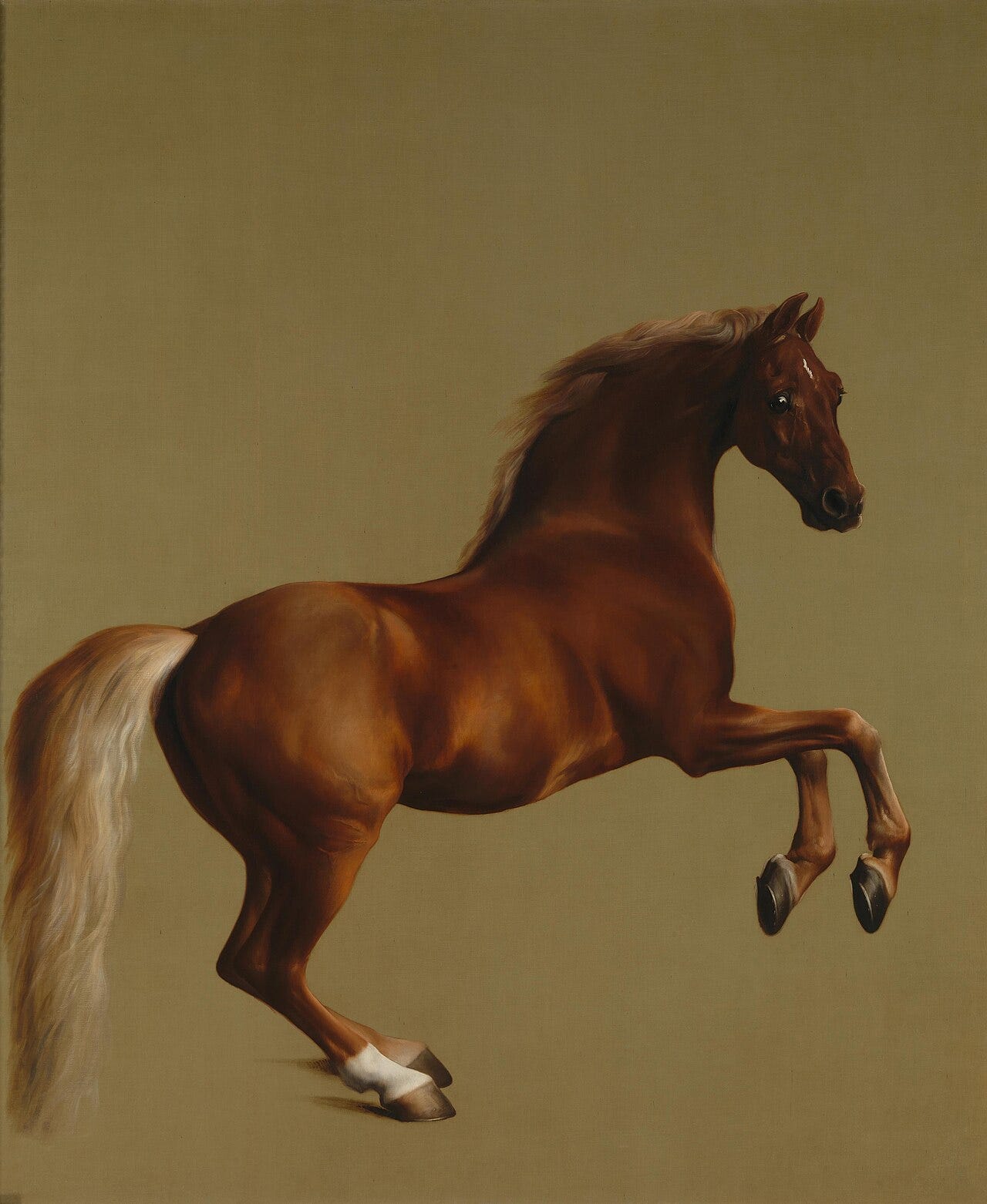
1. George Stubbs, Whistlejacket (about 1762)
This is a life size portrait of a racehorse with no rider, no saddle and nothing behind it, just the animal alone against bare canvas.
To paint it, Stubbs had spent eighteen months in a barn dissecting dead horses to learn exactly how they were built.
That study shows in every tendon of Whistlejacket, a champion Thoroughbred with the flaxen mane of his Arabian bloodline, owned by the Marquess of Rockingham.
A studio legend says the living horse reared at the finished picture, thinking it saw a rival. Now in the National Gallery in London, it is treated as the greatest horse portrait ever painted.
People still argue over whether a figure of the king was meant to fill that empty background and never got added.
2. Rosa Bonheur, The Horse Fair (1855)
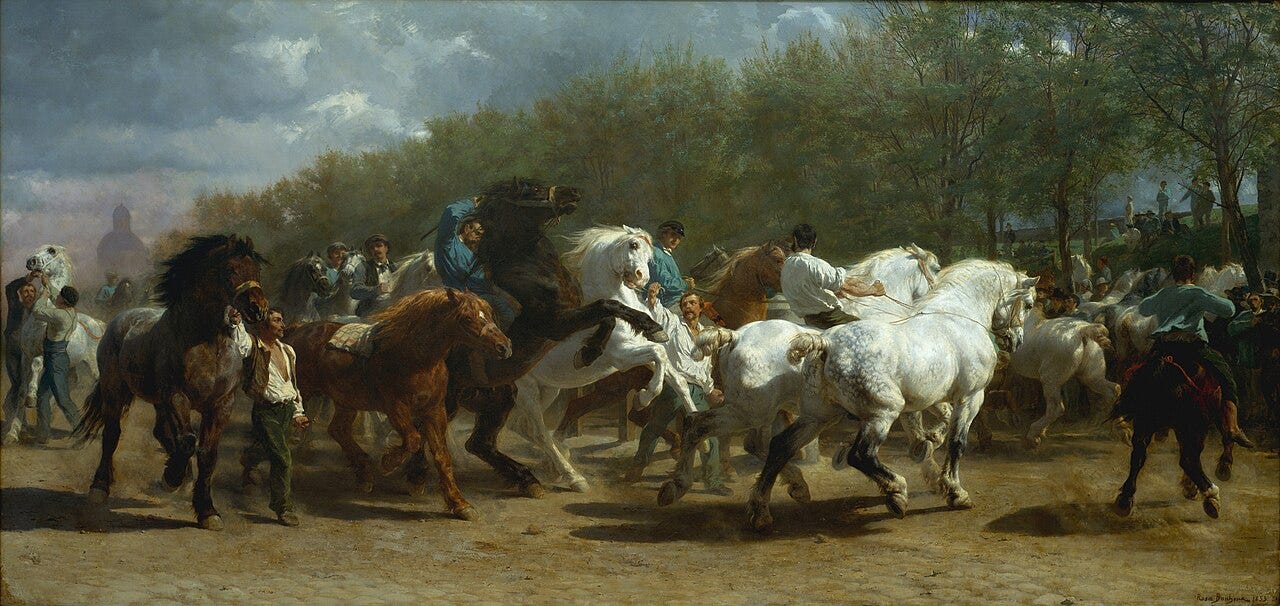
Bonheur painted a thundering line of heavy draft horses being led to market in Paris, and it made her the most famous woman artist of the century.
To sketch the real horse market she got a police permit to wear men's trousers, since a woman in skirts among the dealers drew too much attention.
The canvas is huge, almost five metres wide, and the animals seem to burst out of it. An American collector bought it and gave it to the Metropolitan Museum in New York, where it still stops people in the doorway.
She earned enough from prints of it to buy a chateau and fill it with pet lions. I dig into her whole life in my piece on the women old masters history forgot.
3. Han Gan, Night Shining White (about 750)
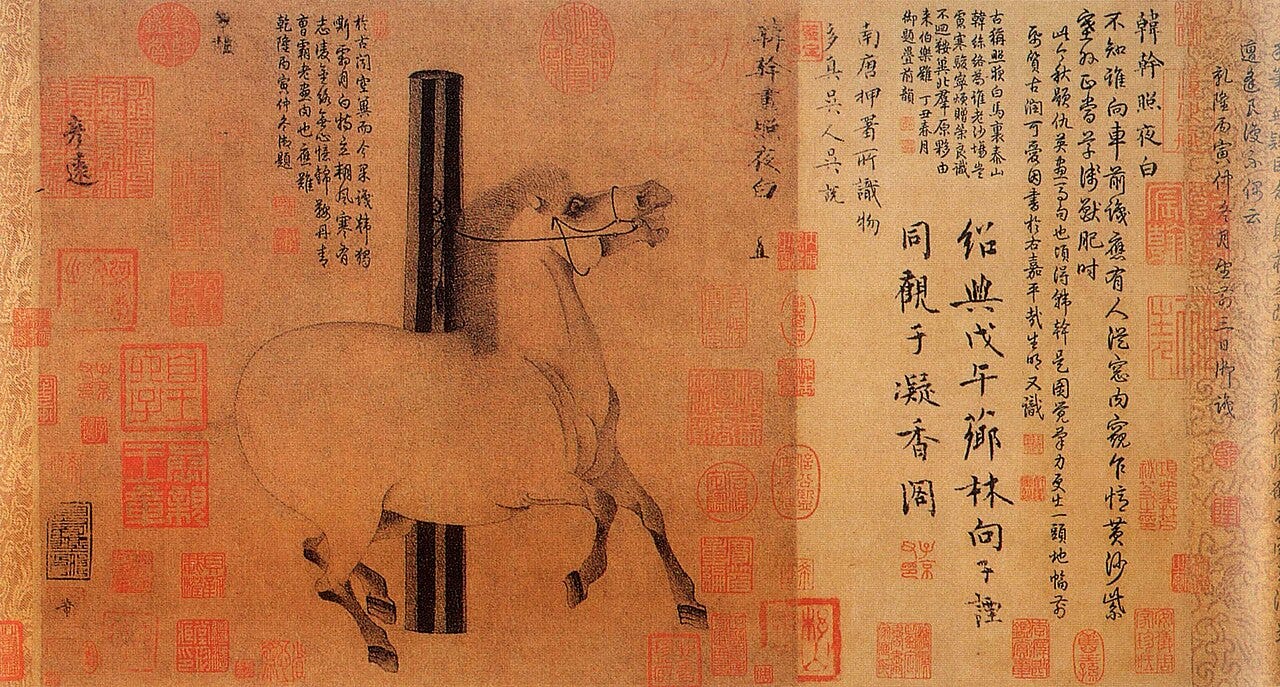
The oldest painting here shows a single white stallion tied to a post, straining against the rope with its nostrils flared, drawn in ink about thirteen hundred years ago.
Night Shining White was a favorite horse of a Tang dynasty emperor, and Han Gan was the court painter asked to catch its fire. He is said to have refused to copy other painters and studied the real imperial stables instead.
The little scroll is now in the Metropolitan Museum, crowded along its edges with red collectors' seals stamped by every owner across the centuries. It is one of the very few Tang horse paintings left in the world.
4. Paolo Uccello, The Battle of San Romano (about 1440)
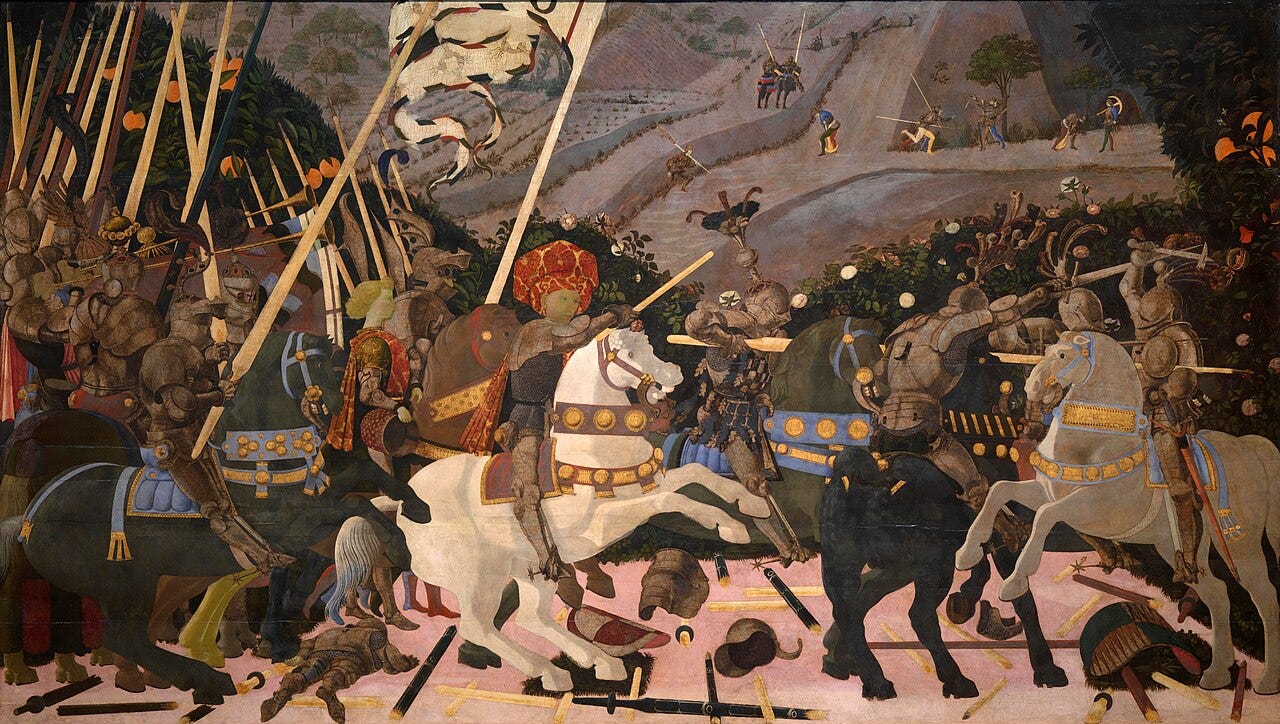
Uccello was so taken with the new science of perspective and foreshortening that he turned a real battle into a strange toy world of wooden horses.
The painting shows a Florentine victory over Siena in 1432, with broken lances laid out on the ground like lines on a grid.
The horses rear and fall in careful geometric poses, more like a diagram than a fight. It is one of three panels, now split between London, Paris and Florence, that once hung together in a Medici bedroom.
Uccello loved the puzzle so much his wife said he stayed up all night muttering about perspective instead of coming to bed.
5. Diego Velazquez, Prince Baltasar Carlos on Horseback (1635)
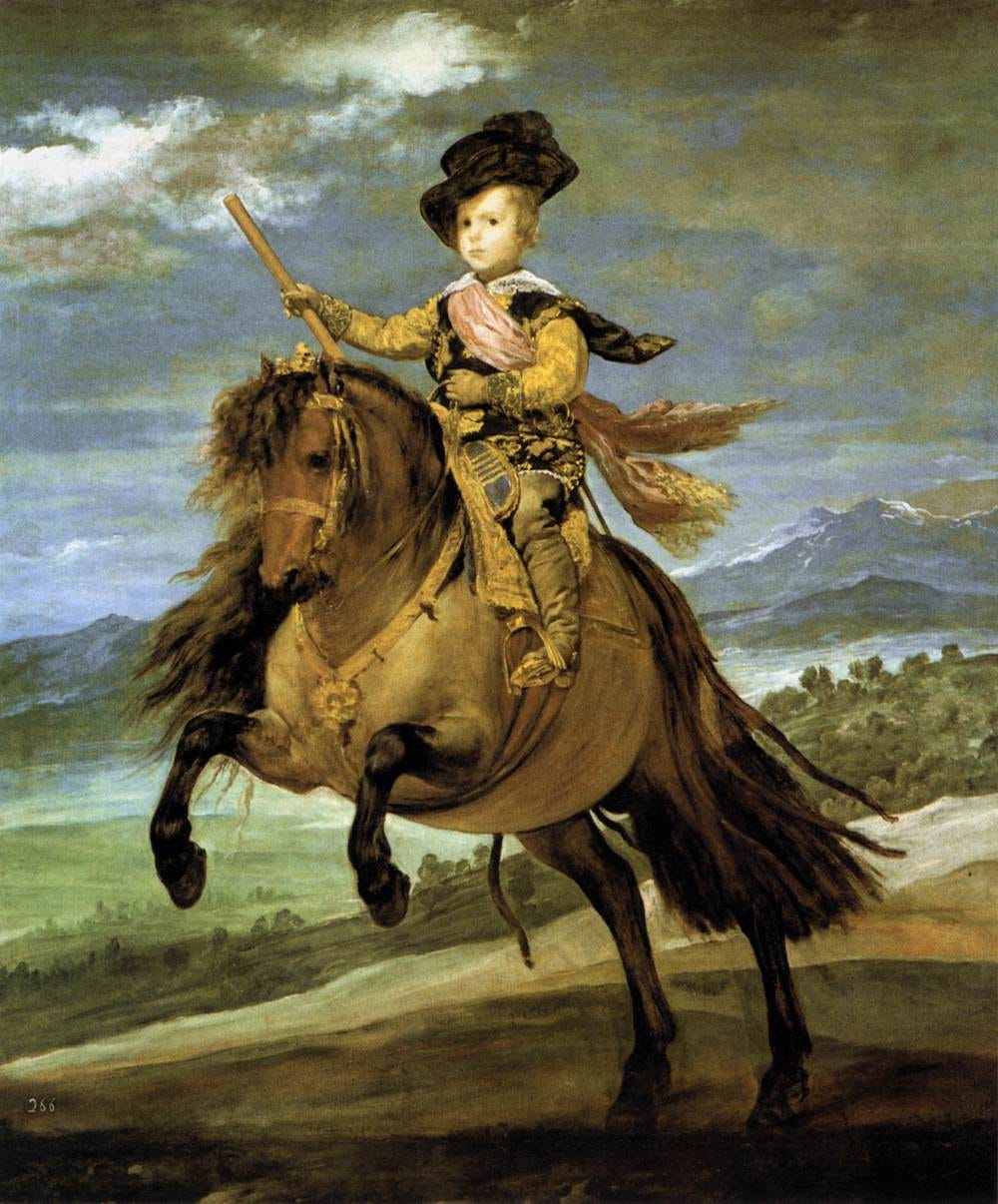
A small boy on a round pony rears up against a mountain sky, dressed in gold armor and a pink sash, and he was the heir to the whole Spanish empire. Velazquez painted the prince at about five years old for a new throne room in Madrid.
The pony's belly is so fat because the picture was meant to hang high on a wall and be seen from below, where the shape would read correctly.
The boy died at sixteen, before he could ever take the throne, and the proud little portrait in the Prado became a picture of a future that never came.
6. Jacques Louis David, Napoleon Crossing the Alps (1801)
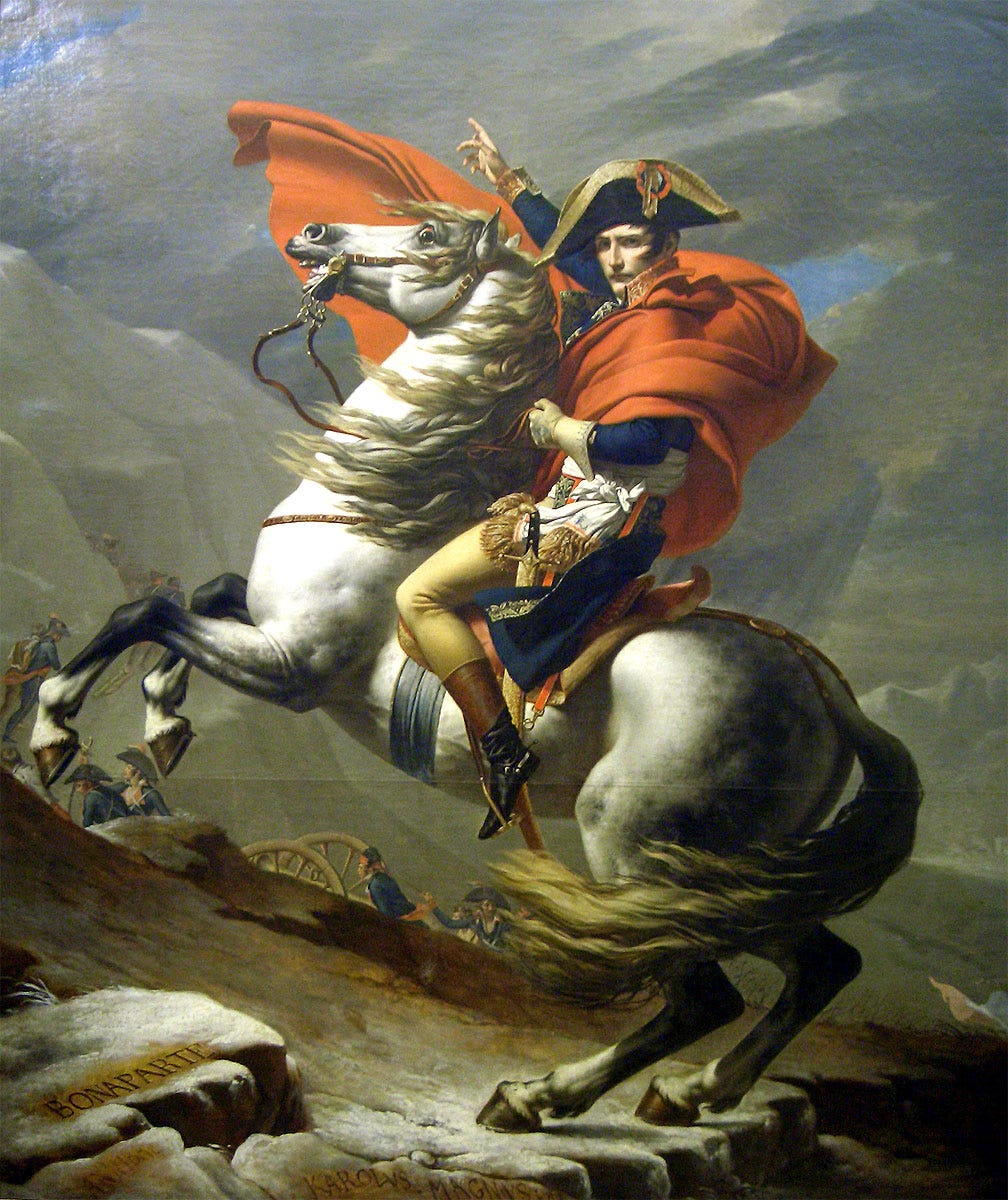
Napoleon rears on a wild stallion, cloak snapping in the wind, pointing his army over the mountains into Italy. Almost none of it was true. The real crossing was made days behind the troops on a sure footed mule, led by a local guide over the snow.
Napoleon refused to sit for the portrait and told David only that he wanted to look calm on a rearing horse. David obliged with pure propaganda, and it worked so well he painted five versions.
The names of earlier conquerors, Hannibal and Charlemagne, are carved into the rocks beneath Bonaparte's own.
7. Theodore Gericault, The Derby at Epsom (1821)
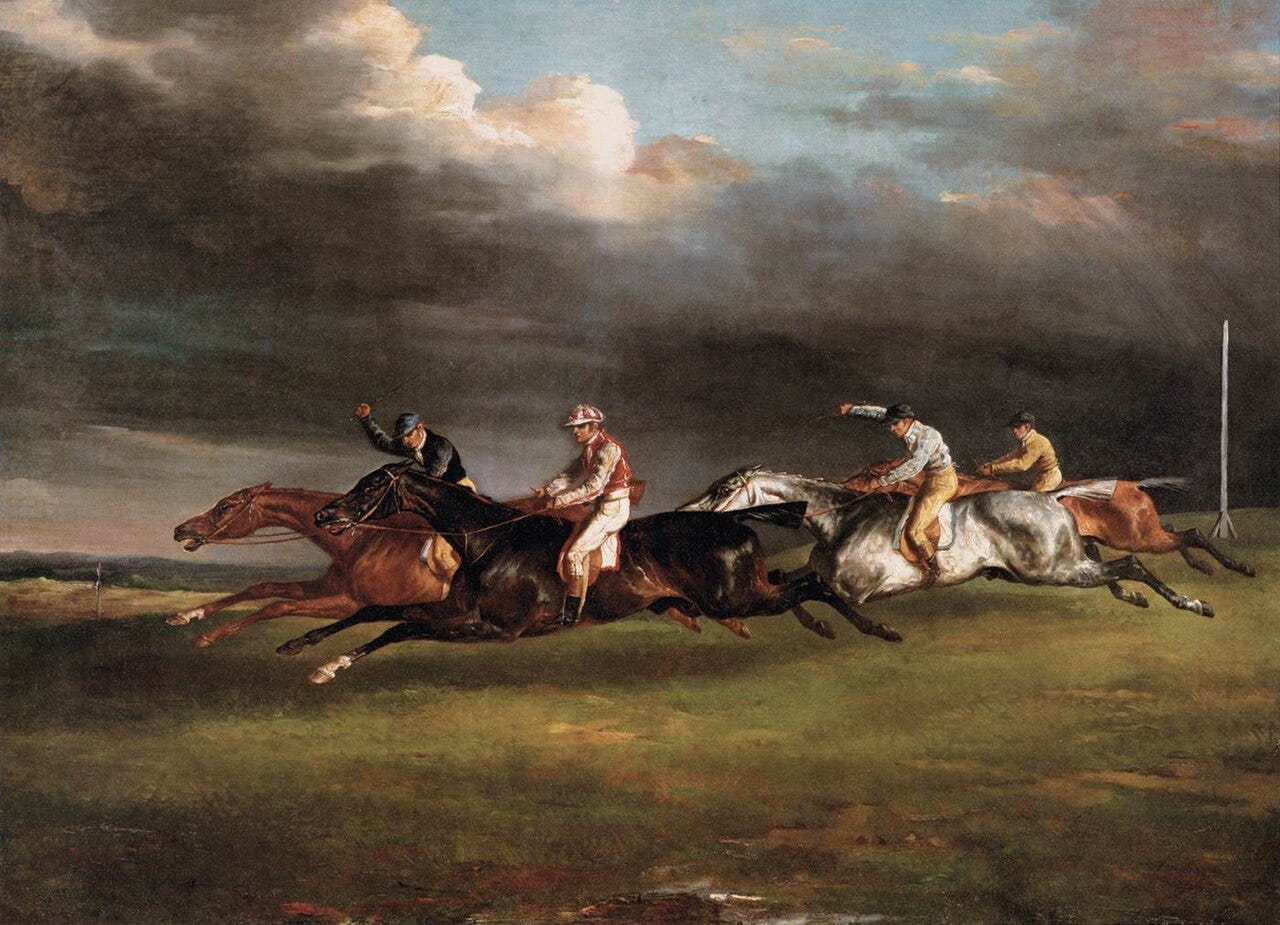
Gericault froze four racehorses at full gallop with all their legs stretched out flat, front and back, like rocking horses in flight. It is beautiful and completely wrong.
No horse actually moves that way, as photographs would prove fifty years later, when Eadweard Muybridge showed a galloping horse always keeps a hoof near the ground.
Gericault painted it in England, where he had fallen for the racing world. He died three years later at thirty two after a run of riding accidents, thrown from the very animals he loved to paint.
8. Eugene Delacroix, Horse Frightened by Lightning (about 1824)
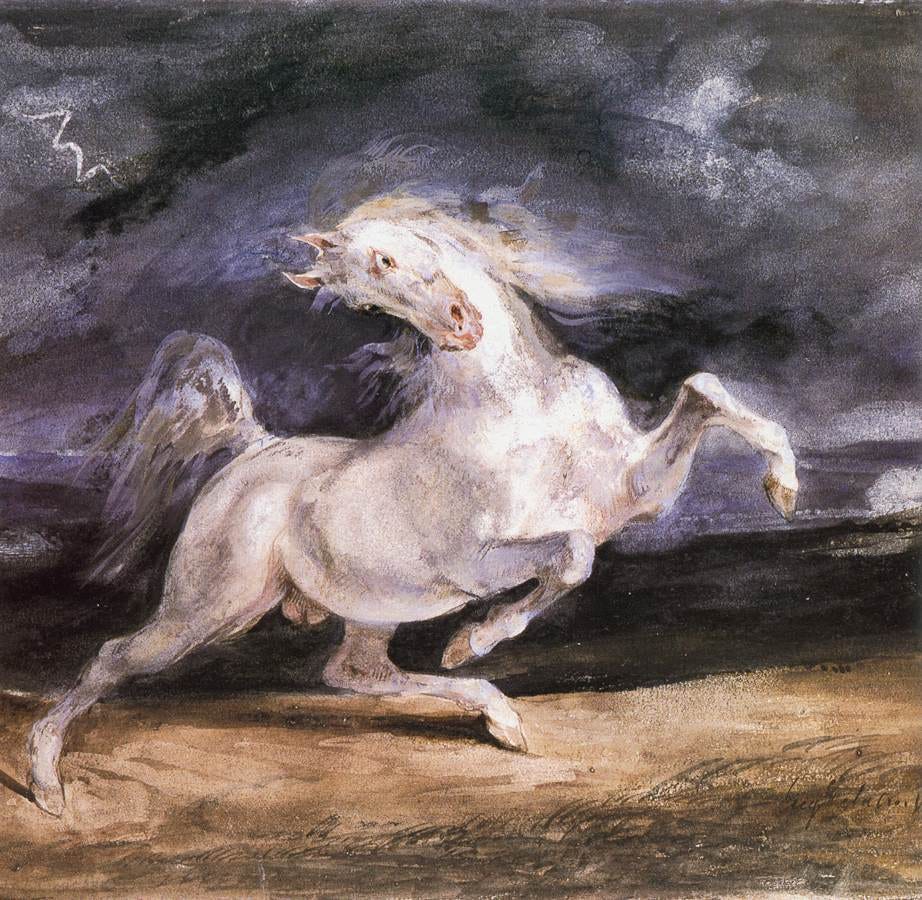
Delacroix caught a single riderless horse the instant a storm breaks over it, muscles bunched, eyes rolling white with terror. There is no rider and no story, just raw animal fear.
He worked it in watercolor, loose and fast, trying to seize the feeling rather than the details. He filled notebooks with horses and even watched them cut open at the knacker's yard to learn the bodies underneath.
Now in Budapest, the small sheet is barely larger than a page of writing paper, yet the panic in it fills a whole wall.
9. Henry Fuseli, The Nightmare (1781)
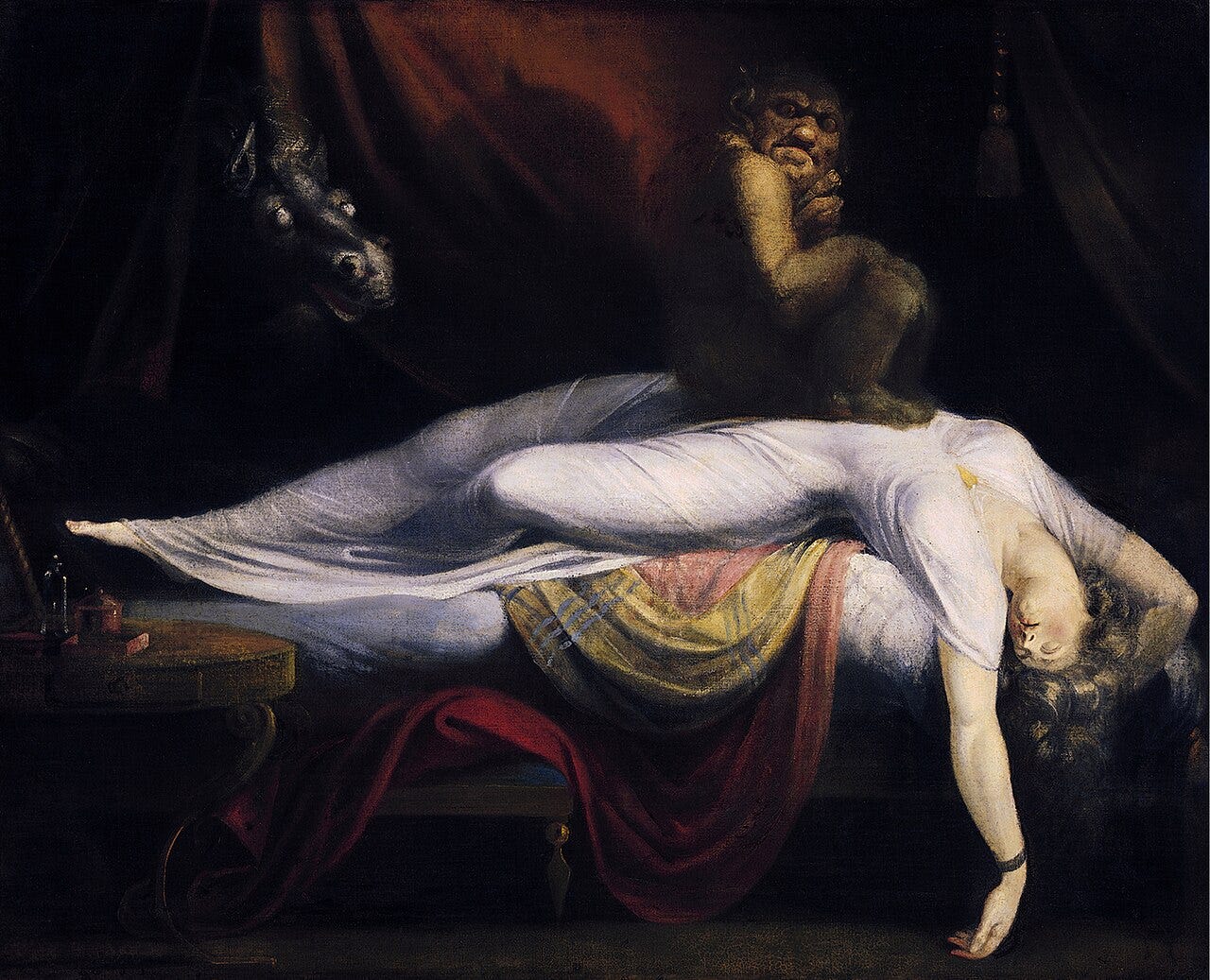
A woman lies flung back in sleep while a squat demon crouches on her chest and a pale horse with blank white eyes pushes its head through the curtains.
The horse gives the picture its name, a play on the old word for a night spirit. Fuseli never explained it, and audiences at the 1782 Royal Academy show found it thrilling and improper at once.
Prints of it sold by the thousand, and Sigmund Freud is said to have kept a copy on his wall over a century later. The staring horse became one of the first true images of a bad dream in Western art.
10. Edgar Degas, Gentlemen's Race, Before the Start (about 1862)
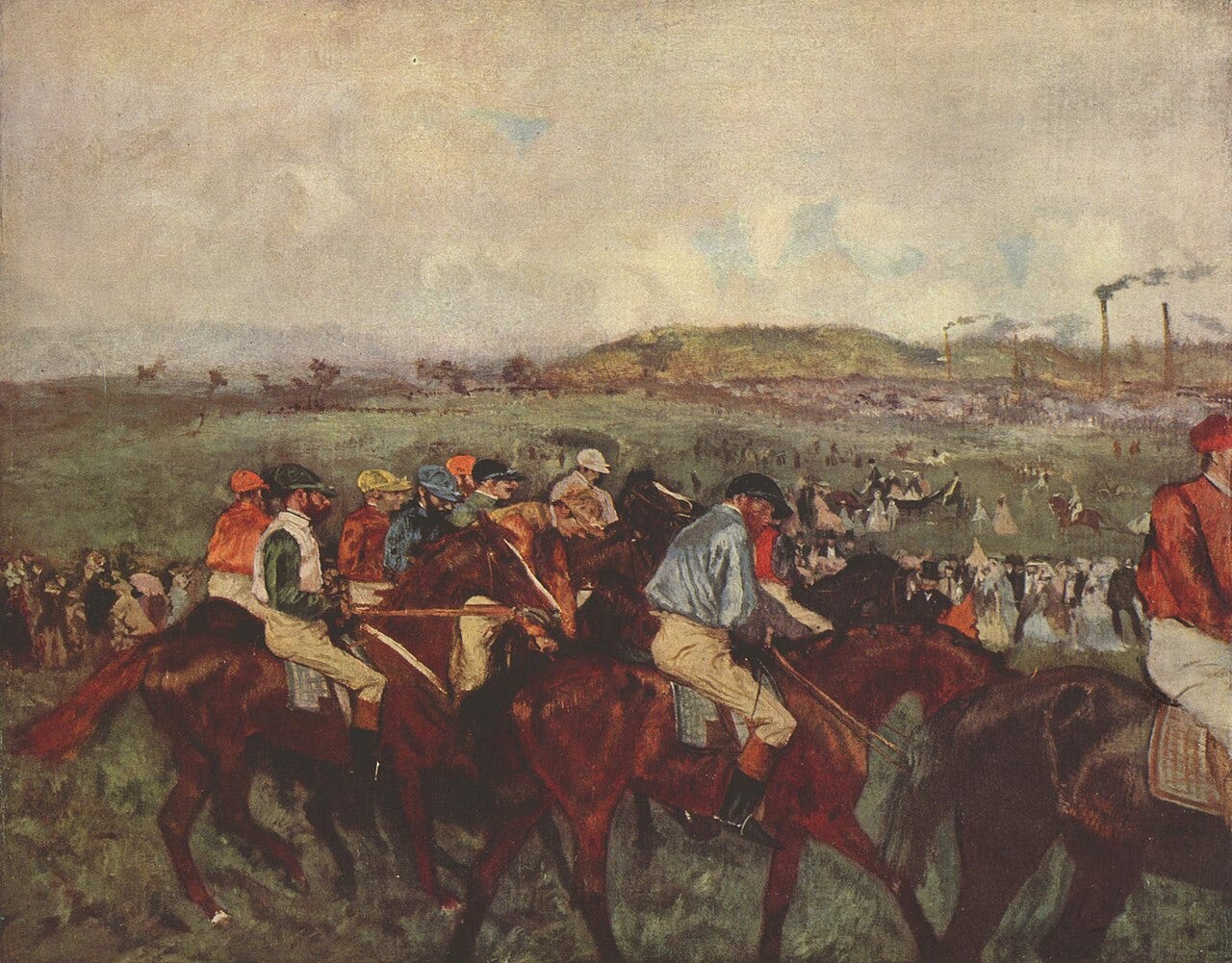
Degas is remembered for ballet dancers, but he painted the racetrack just as often, drawn to the same nervous, trained bodies waiting to perform.
Here jockeys in bright silks hold their mounts in check before a race, one horse breaking loose across the front.
He built the scene in the studio from memory and small wax models, not from life at the track. That off center gap of empty field on the left, with the crowd tiny in the distance, came straight from the Japanese prints he collected by the hundred.
11. Franz Marc, The Large Blue Horses (1911)
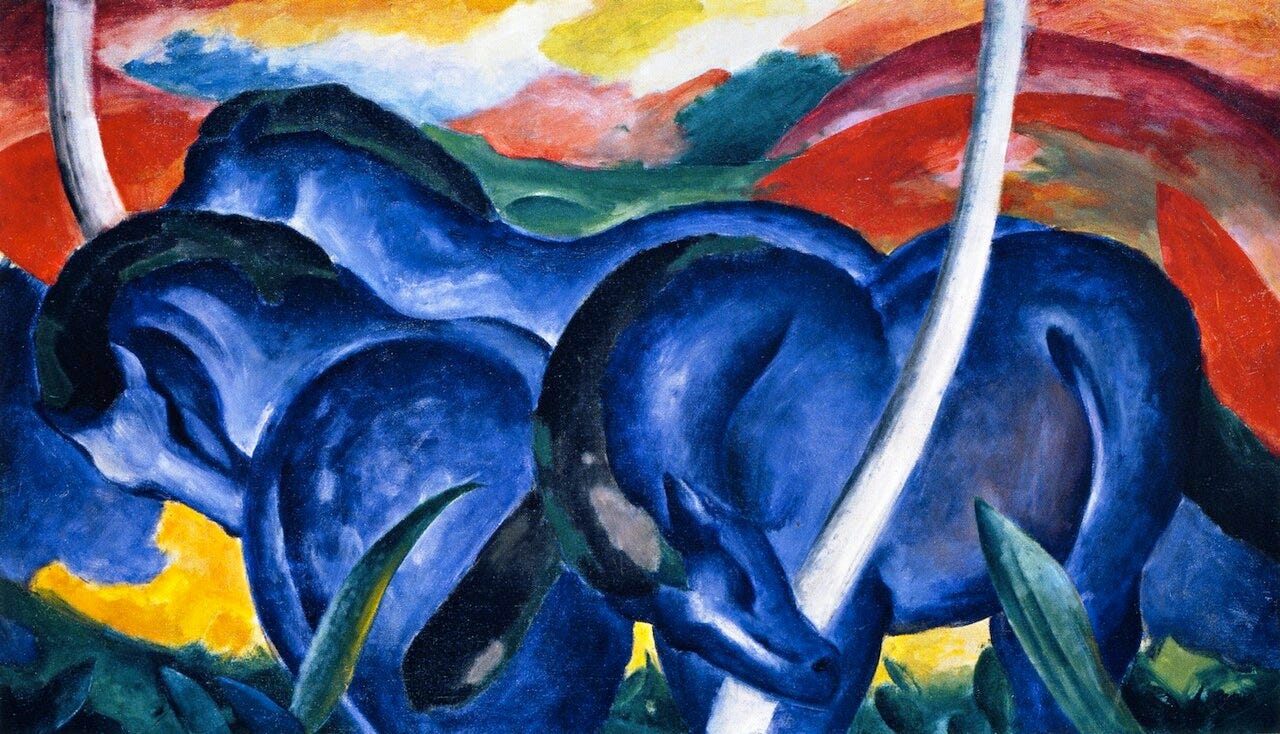
Three round blue horses curve together into a single soft shape against hills of red and yellow. Marc believed animals were purer than people and gave each color a feeling, blue for the spiritual, so a blue horse was almost a prayer.
He helped found a group of Expressionist painters called the Blue Rider in Munich the next year, and the picture now hangs in Minneapolis. Marc was killed at Verdun in 1916, aged thirty six, one of a whole generation of painters lost in the war.
12. Frederic Remington, A Dash for the Timber (1889)
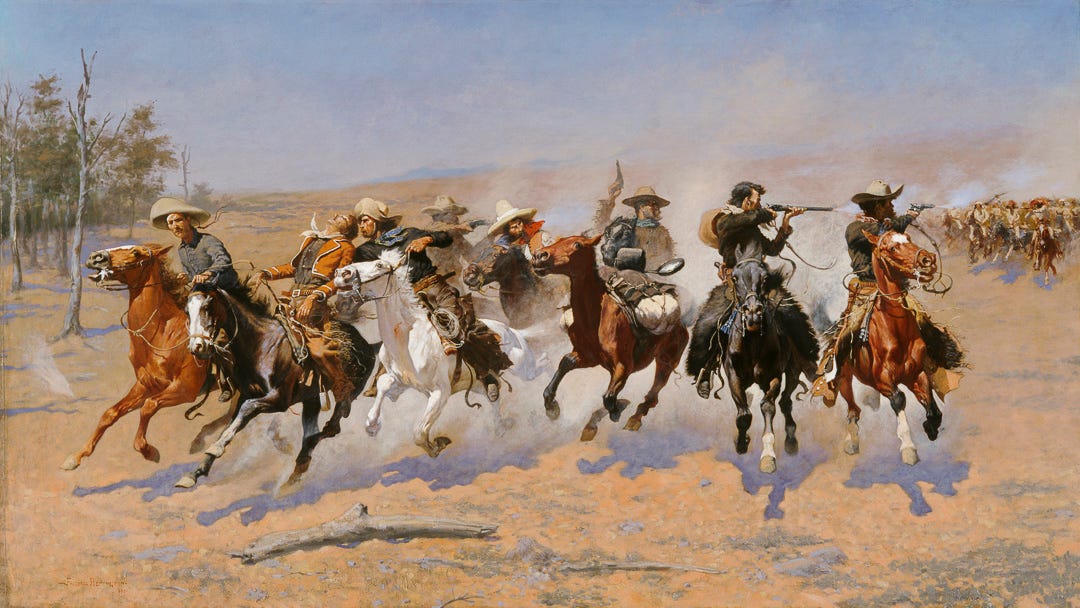
Eight cowboys ride straight at the viewer at full speed, firing back over their shoulders at pursuers, in a cloud of dust and hooves.
Remington built his whole career on the American West just as it was vanishing, and this early canvas made his name overnight.
He studied real cavalry horses and later studied Muybridge's new motion photographs to get the legs right, dropping the old flying gallop. Every horse moves differently, one stumbling, one at full stretch.
It hangs today at the Amon Carter Museum in Fort Worth. The canvas turned a magazine illustrator into the painter of the frontier myth in a single season.
Horses in art, quick answers
What is the most famous horse painting? Stubbs's Whistlejacket, a life size portrait of a single racehorse against bare canvas, usually takes the title.
Why did old paintings show horses galloping wrong? Before photography, painters believed a running horse threw all four legs out flat. Muybridge's 1878 photos proved a hoof is almost always down.
Who is the most famous painter of horses? George Stubbs in Britain and Rosa Bonheur in France are the two names most tied to the horse.
What is the oldest image of a horse? Horses cover the walls of caves like Lascaux, painted about seventeen thousand years ago, long before recorded history.
What does a horse symbolize in art? Power and war above all, but also freedom, wealth and nobility, which is why kings had themselves painted on horseback.
If these horses pulled you in, you will love these too:
Vermeer, Woman Holding a Balance, what is actually on those scales
Inside Monet house at Giverny, room by room, including his own bedroom
The Ambassadors, detail by detail, the object at the bottom that only works from one side
Why we keep painting the horse
For all our machines, the horse still stands for something we do not want to lose, speed and power that stay a little wild. These twelve painters chased the same thing across three thousand years and every continent, the moment a heavy animal turns weightless.
Cars replaced the horse in a single generation, yet no one hangs a loving portrait of the family sedan. The horse got there first, and it kept the crown.