

Painters have used eight animals more than any others to carry meaning: the lion for power, the wolf for danger, the owl for wisdom or folly, the snake for temptation, the horse for status, the bird for the soul, the cat for independence, and the butterfly for change.
Each animal carried its own reputation long before it reached a canvas. Painters used what audiences already believed, then sometimes bent it, corrected it, or turned it upside down.
This guide walks through all eight, with the paintings, the artists, and a few facts that rarely make it into the caption.
More secrets hidden in plain sight
If uncovering these symbols got you hooked, these paid deep dives go even further:


The Lion: Power, Faith, and Danger
The lion is the oldest symbol of raw power in Western art. Christian painters used it for the evangelist Mark and for Christ risen from the tomb. Court painters used it whenever a ruler wanted to look untouchable.
Peter Paul Rubens finished The Lion Hunt in 1621, now in the Alte Pinakothek in Munich. Two lions twist into a wall of spears, horses, and falling men, in a painting Eugène Delacroix later called his favorite among all of Rubens hunting scenes.
The full range, from Rubens and Rembrandt to Henri Rousseau dreaming lion in the moonlight, is in our guide to famous lion paintings.
The Wolf: Danger and Devotion
European folklore made the wolf a villain, the beast waiting in the forest for grandmothers and stray children. Roman legend told the opposite story. The she-wolf Lupa nursed the abandoned twins Romulus and Remus, and that image, the wolf as mother, spread across Roman and later Renaissance art.
Painters kept switching between the two roles, hunter and nurse, across the works gathered in our guide to wolf paintings.
The Owl: Wisdom, or Its Opposite
Athens is where the wise owl comes from. The bird belonged to the goddess Athena, and its presence marked knowledge and clear judgment across Greek art and coinage.
Painters north of the Alps read the same bird in reverse. In the work of Hieronymus Bosch and other Netherlandish artists, the owl often stands for folly or sin, precisely because it is a creature of the night that cannot bear daylight. The same feathers meant intelligence in Athens and blindness in Bruges.
See both readings at work in our guide to owl paintings.
The Snake: Temptation and Eternity
In Genesis, the serpent talks Eve into eating the forbidden fruit, and Western painters spent centuries illustrating that single moment. The snake became shorthand for temptation itself.
It also meant the opposite. A snake biting its own tail, the ouroboros, stood for eternity and the cycle of time, a symbol older than Christianity that artists kept borrowing. In the Vatican Museums, the marble group Laocoön and His Sons, rediscovered in Rome in 1506, shows serpents sent by the gods to kill a priest who tried to warn Troy. Danger, punishment, and endless time all lived in the same animal.
The full range is in our guide to snake paintings.
The Horse: Power and Propaganda
A horse under a ruler has meant status since ancient Rome, where equestrian statues of emperors filled public squares. Painters never stopped using the trick.
Jacques Louis David painted Napoleon Crossing the Alps in 1801, a rearing white stallion under a general pointing toward glory. The real crossing, made in 1800, happened on a mule, led carefully along an icy path. David painted the propaganda Napoleon wanted, not the animal that actually carried him.
More power, more horses, and more true stories behind the paint, in our guide to horse paintings.
The Bird: Freedom and the Soul
Birds carried the lightest symbolism and the heaviest one at once. A dove could mean peace or the Holy Spirit. Any small bird could stand for the soul, free of the body, or for the thin line between life and captivity.
Carel Fabritius painted The Goldfinch in 1654, now in the Mauritshuis in The Hague. The bird sits on top of its feeding box, a thin chain around one leg. It is one of the most famous prisoners in the history of painting, and it never once looks caged.
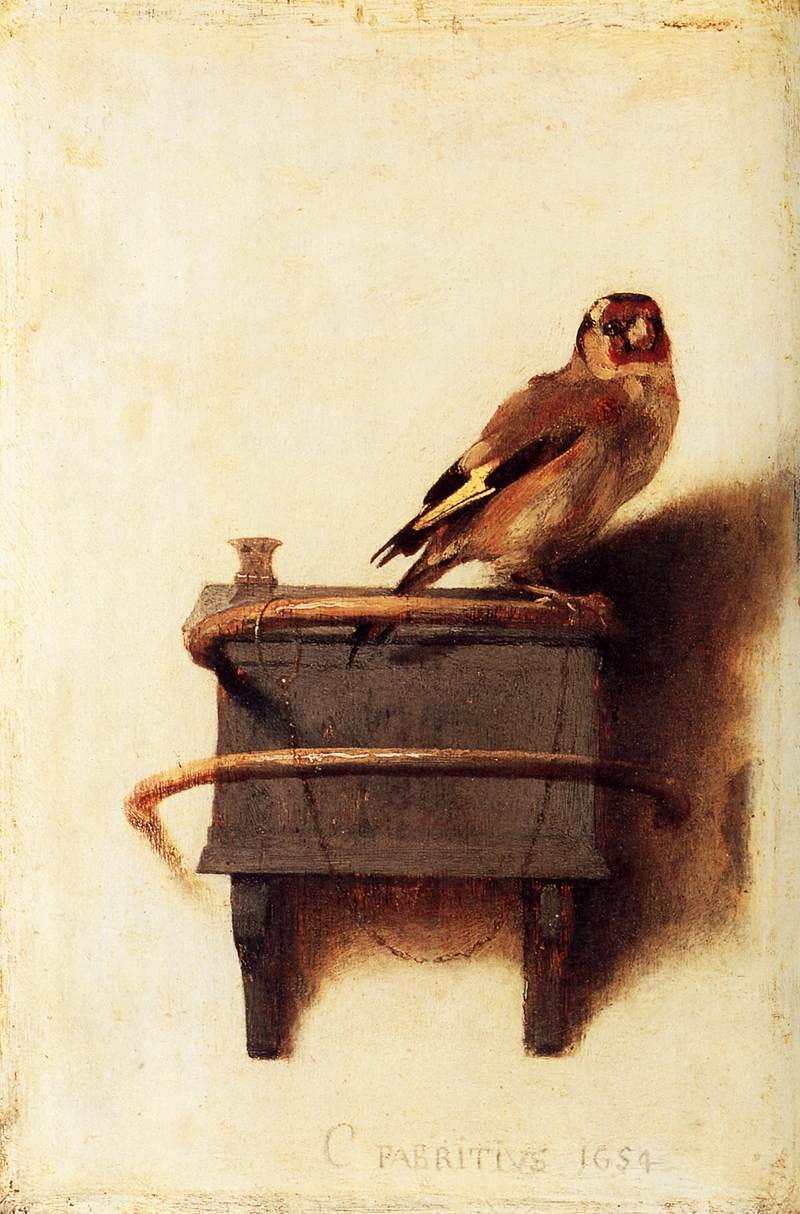
The rest of the flock is in our guide to bird paintings.
The Cat: Independence and Scandal
Ancient Egypt worshipped the cat as sacred to the goddess Bastet. Centuries later in Paris, the same animal could still cause a scandal.
Édouard Manet placed a small black cat, arched and hissing, at the foot of the bed in Olympia, shown at the Paris Salon of 1865. Critics already furious at the nude read the cat as one more sign of the woman's independence and her trade. The Musée d'Orsay still displays the painting that broke the rules of the Salon in a single afternoon.
Manet was far from alone. Meet more painters who could not resist a cat in 21 Famous Painters With Their Cats, and see the full gallery in our guide to cat paintings.
The Butterfly: The Soul in Greek Art
In Greek, the word psyche means both soul and butterfly. Painters and sculptors used that overlap directly, showing the soul leaving the body as a small winged insect rather than a human figure.
A butterfly life is short, which made it a natural fit for vanitas paintings, the still lifes built to remind a viewer that beauty and time both run out. A single wing in the corner of a flower painting was often enough to make the point.
The full set of transformations is in our guide to butterfly paintings.
Animals in art, questions people ask
What animal appears most often in Western painting? No single animal wins across every period, but the lion, the dog, and the horse keep returning, since all three could stand for power, loyalty, or status depending on the scene.
What does a lion symbolize in art? Power, faith, and danger, depending on the context. In Christian painting it can mean the evangelist Mark or the risen Christ. In court portraits and hunting scenes it usually just means strength.
Why is the owl linked to wisdom in art? The link comes from ancient Greece, where the owl belonged to Athena, goddess of wisdom. Christian painters in Northern Europe often reversed the meaning later, using the owl for folly instead.
Are black cats always a symbol of evil in art history? No. In Manet's Olympia the black cat signals independence and sexuality rather than evil, and in ancient Egyptian art the cat was sacred rather than sinister. The purely evil black cat owes more to later folklore than to painting.
What animal represents the soul in painting? The butterfly, borrowed from the Greek word psyche, which means both soul and butterfly. Birds carry a similar meaning in Christian art, especially the dove.
What do crows and ravens mean in painting? They carry their own separate history, from medieval omens of death up to Van Gogh's wheatfield. This piece follows the bird century by century, and clears up the myth that the wheatfield painting was his last.
What do rabbits and hares mean in painting? Depending on the century, the same animal has stood for purity, lust, or resurrection. A closer look at the motif runs from Durer's watercolour to the killer rabbits hiding in medieval manuscript margins.
Where these paintings hang
Alte Pinakothek, Munich: Rubens, The Lion Hunt, 1621.
Musée d'Orsay, Paris: Manet, Olympia, 1863.
Mauritshuis, The Hague: Fabritius, The Goldfinch, 1654.
Vatican Museums, Rome: Laocoön and His Sons, rediscovered in 1506.
Château de Malmaison and museums in Vienna and Berlin: David painted five versions of Napoleon Crossing the Alps between 1801 and 1805.
More hidden symbols to unlock
Three more paintings, three more secrets:


Rubens finished The Lion Hunt in 1621. It still hangs in the Alte Pinakothek in Munich, the painting Eugène Delacroix later called his favorite among all of Rubens hunting scenes.
Dogs return just as often across this tradition, from royal court portraits to scenes of everyday loyalty. The paintings and the artists are in our guide to famous dog paintings.
A simple fish drawing worked as a password among early Christians long before Bosch painted the animal into hell scenes, a history covered in our guide to fish and sea creatures in painting.
Few painters had ever seen a live bear, which explains the strange anatomy running through medieval bestiaries and even Shishkin's own Russian forest scene, the subject of our article on bears in painting.
Rembrandt once drew Hansken, a touring elephant who became a minor celebrity across seventeenth century Europe, one of twelve works in our guide to elephants in art.
The same animal reads as a biblical plague in one painting and a sign of long life in another, and our piece on frogs and toads in painting traces both traditions.
That famous peacock blue on a painted feather is an optical trick rather than a pigment, one of the details unpacked in our guide to peacocks in painting.
Frida Kahlo kept pet monkeys that turn up across her self portraits, and our article on monkeys in painting gathers twelve examples of the animal used to mock human vanity.
